Tour of North-West Spain,   13/07/2013 - 05/08/2013

Part 1:   Biarritz   →  Arrens-Marsous


Prologue   After a restless night I leave my comfortable bed shortly before the alarm will urge me to, at 10 to 5 a.m.. It's still dark, but not anymore when I lock the front door at 5:30. An easy ride to Rotterdam Airport where (almost) everything goes smoothly (I have to deflate my tubes; nonsense, but what must be done has to be done ...) There was a slight risk of delay owing to the disarming of a world war II bomb 25 km away (and who else but my Mum warned me of this!), but the plane leaves and arrives well according to schedule. My neighbour in flight HV6925 is quite a restless young man in need of incentives all the time; he is almost in shock when it appears he cannot watch the movie he has downloaded the evening before (it's in his bag in the luggage compartment), and is one of the - many - people who get impatient and cannot stay seated one minute longer as soon as the plane has landed.   Around 9:30 a.m. I'm already standing at the conveyor belt.


  13-07-2013     Biarritz – Laugibar     105 km


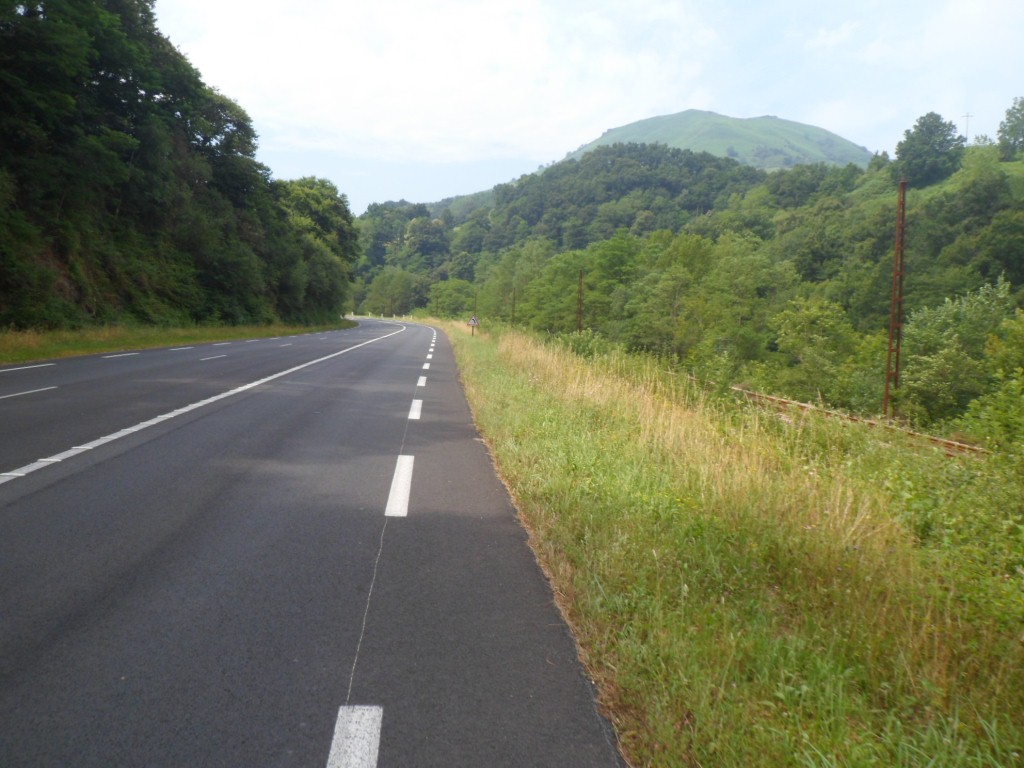
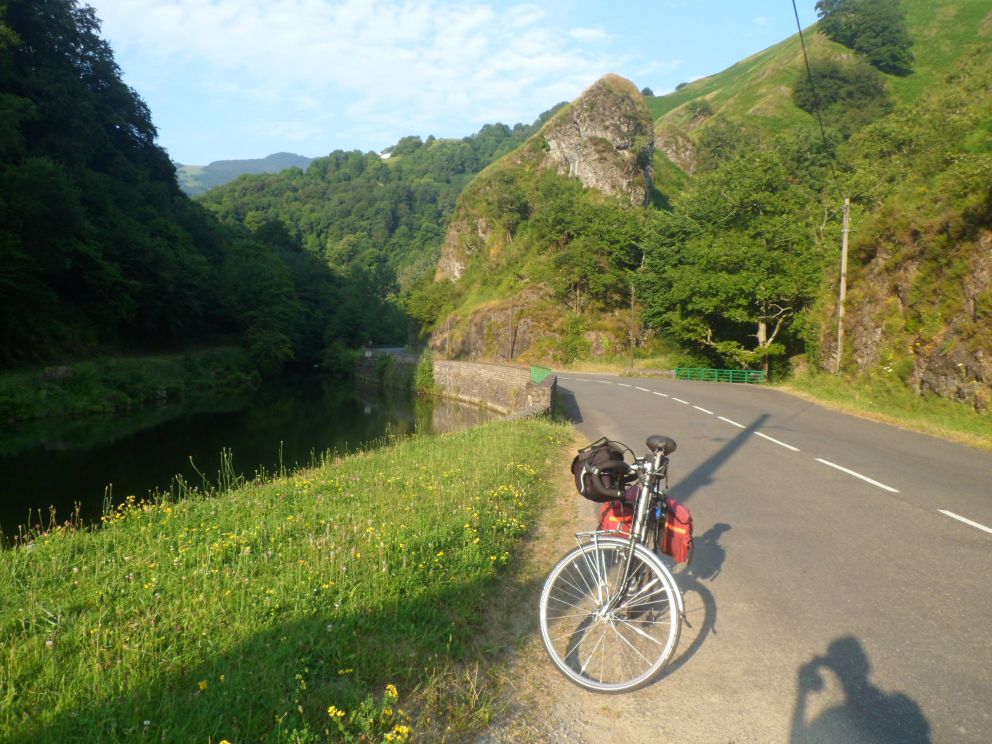
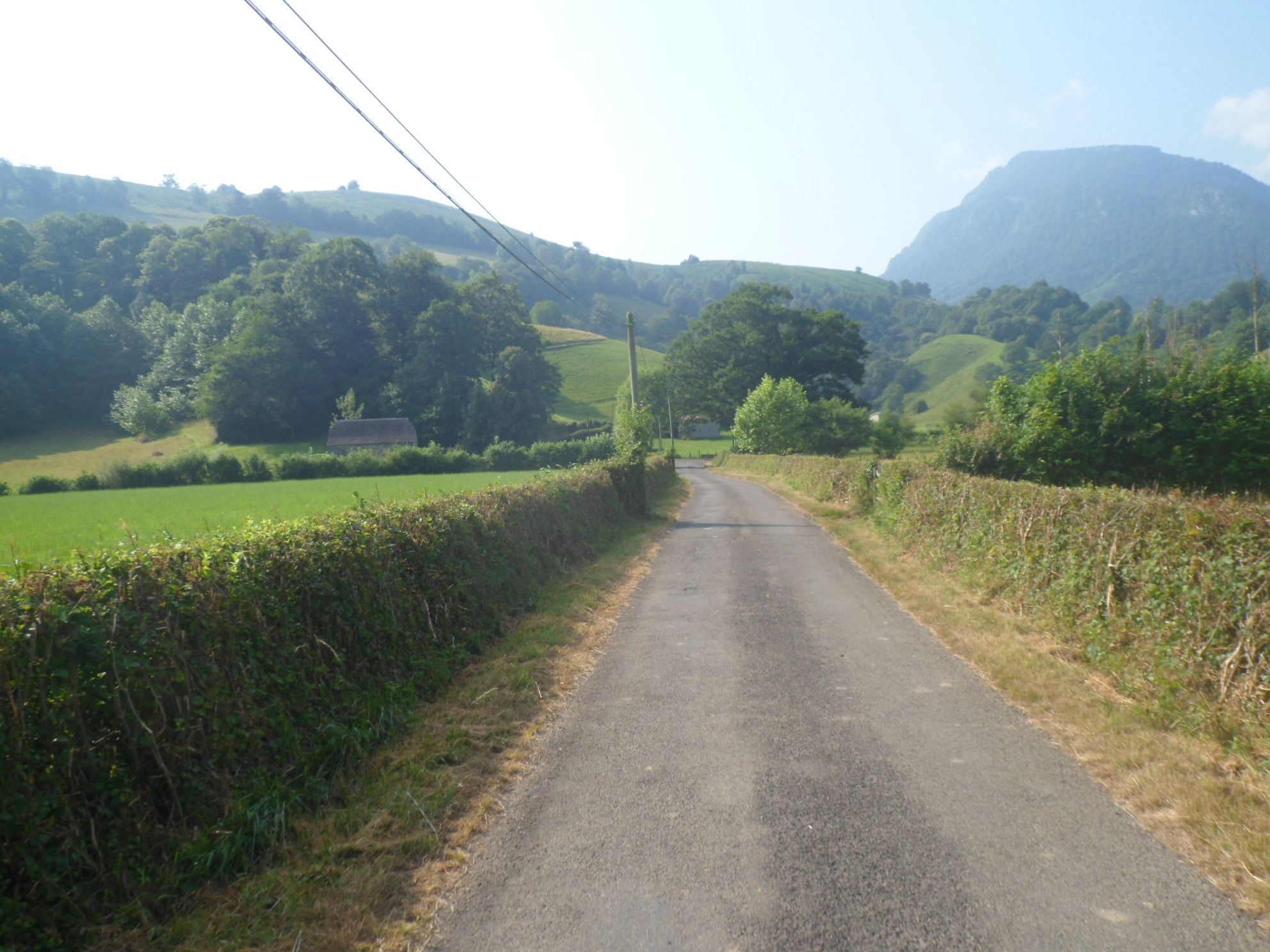
Quiet moment on even D923


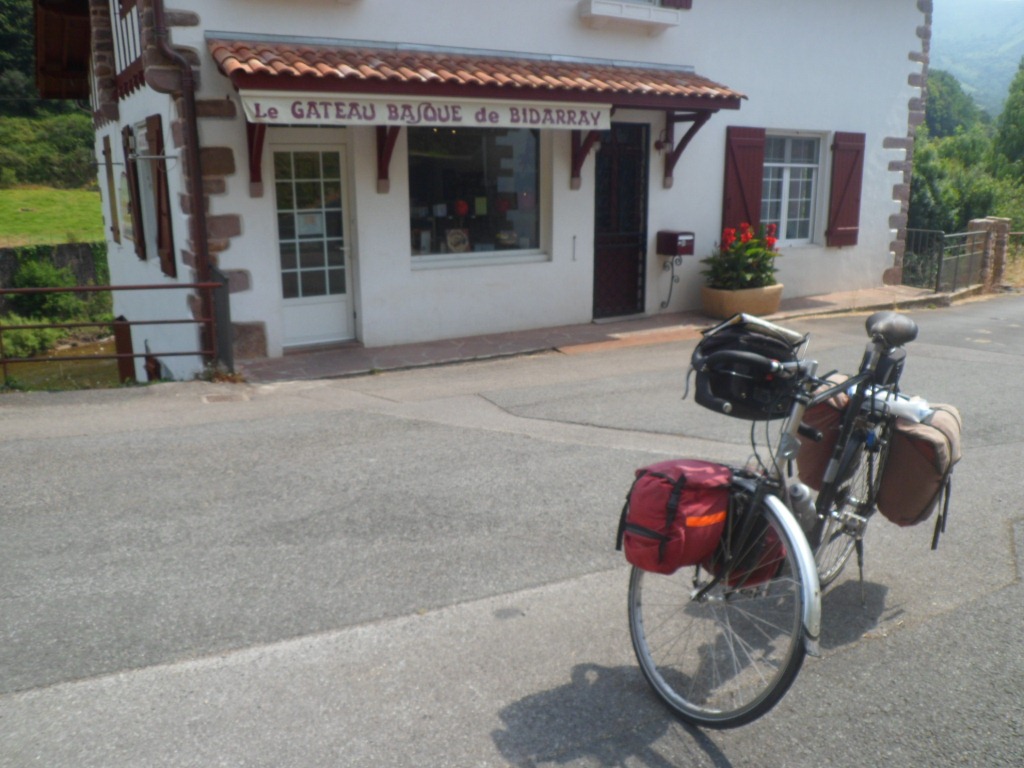
Pâtisserie Basque


Here's where it starts


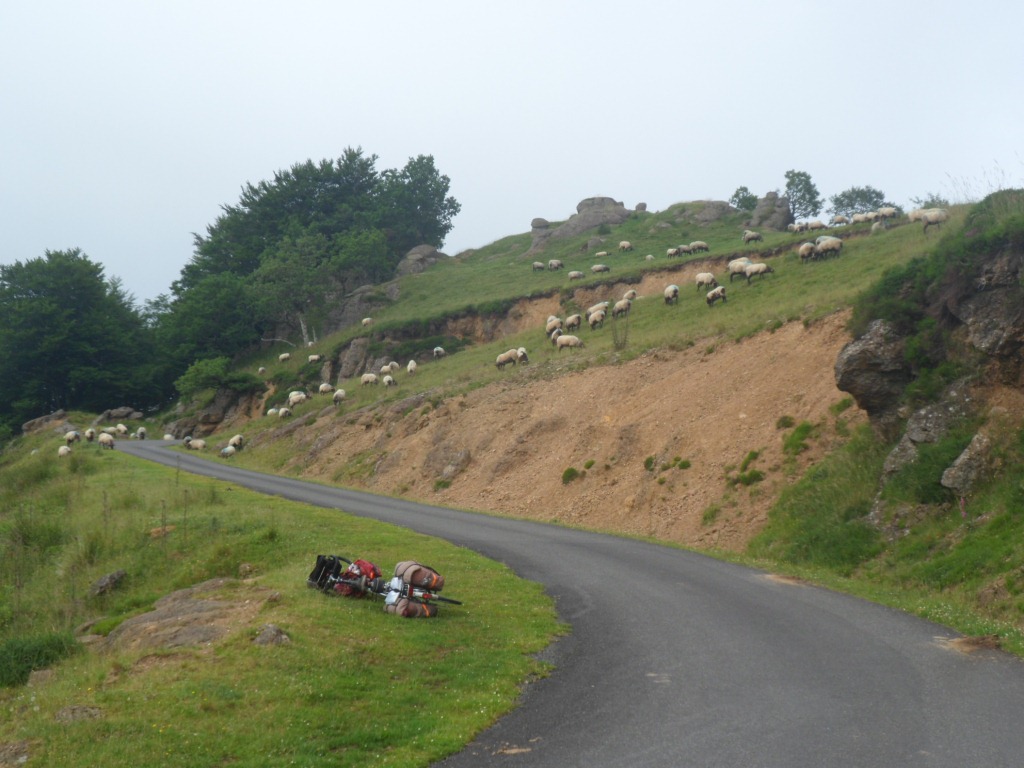
Is my bike as tired as I am?


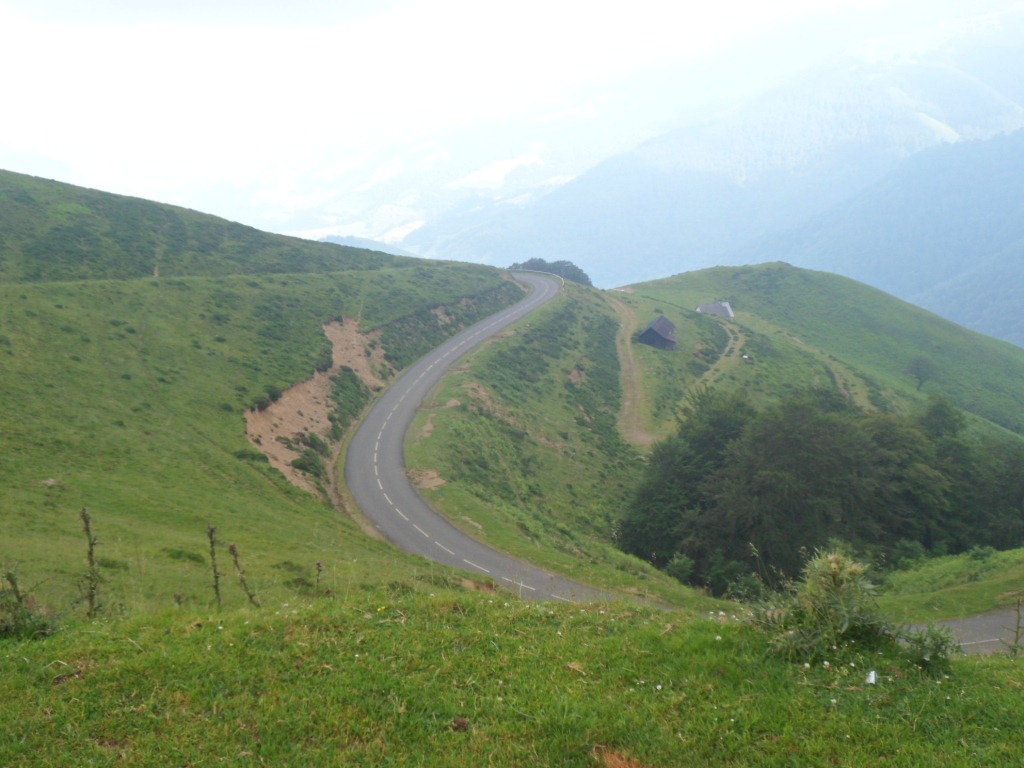
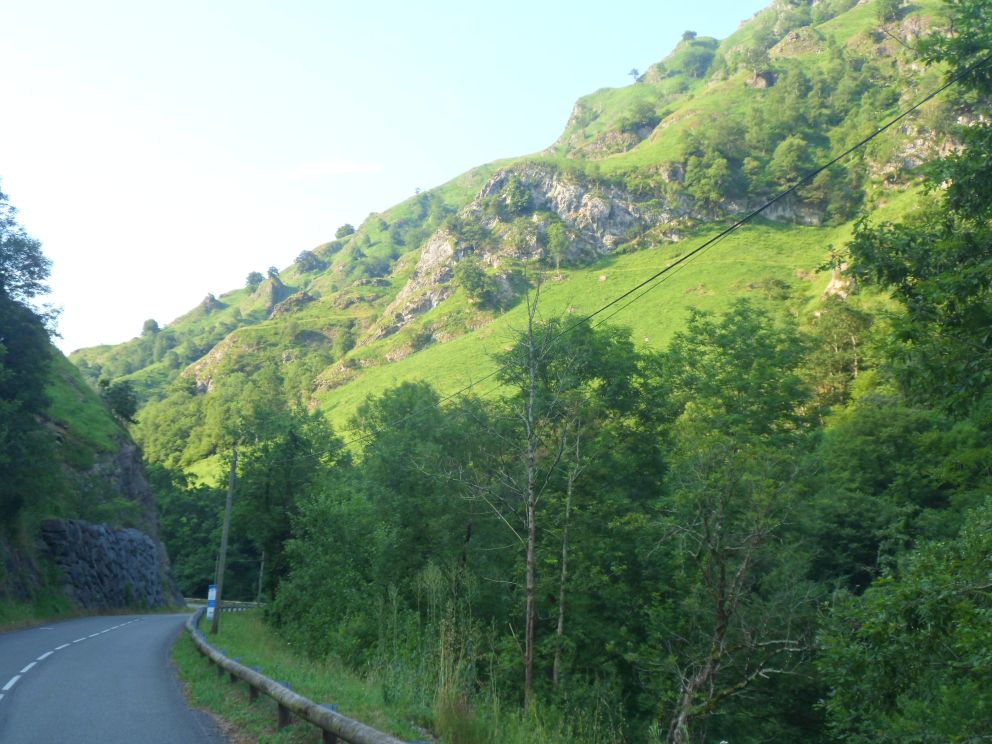
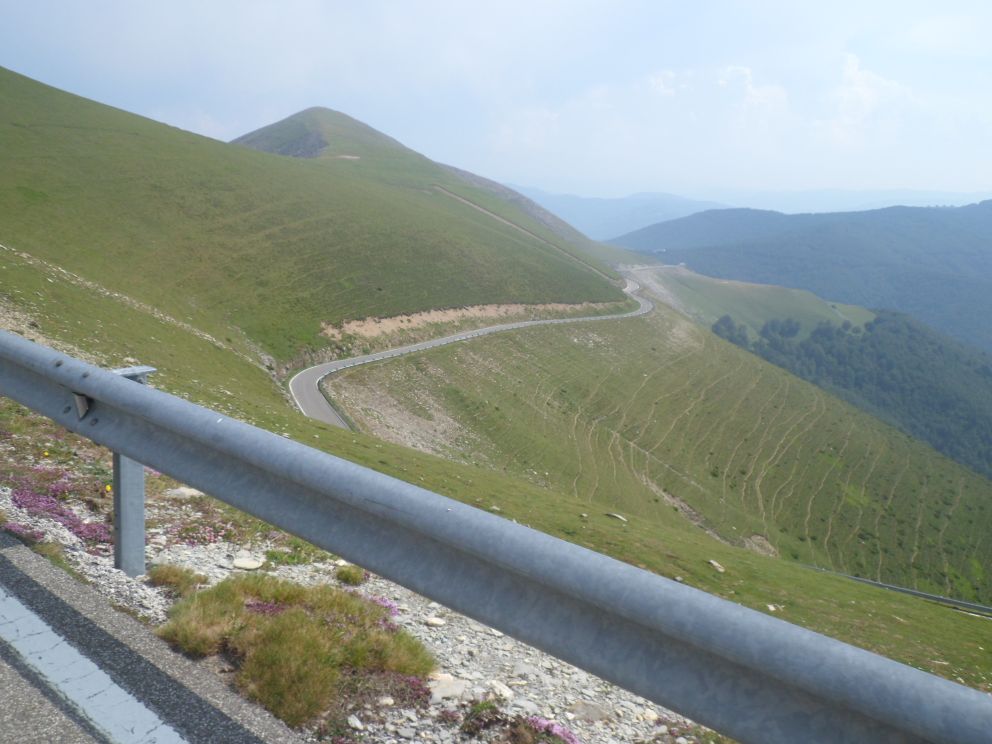
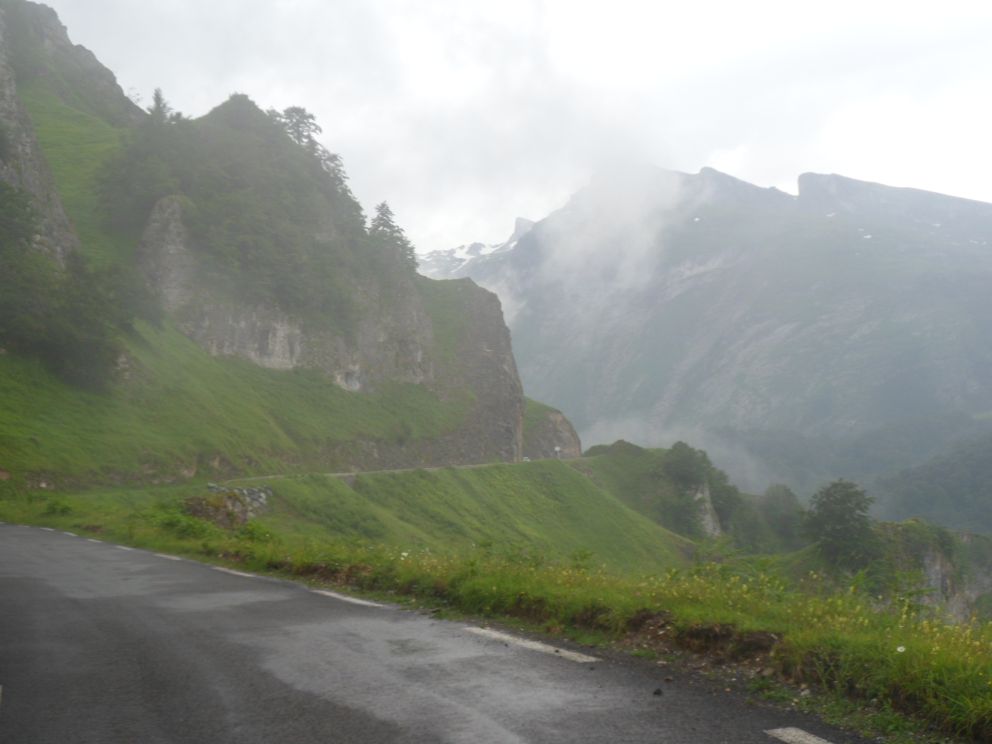
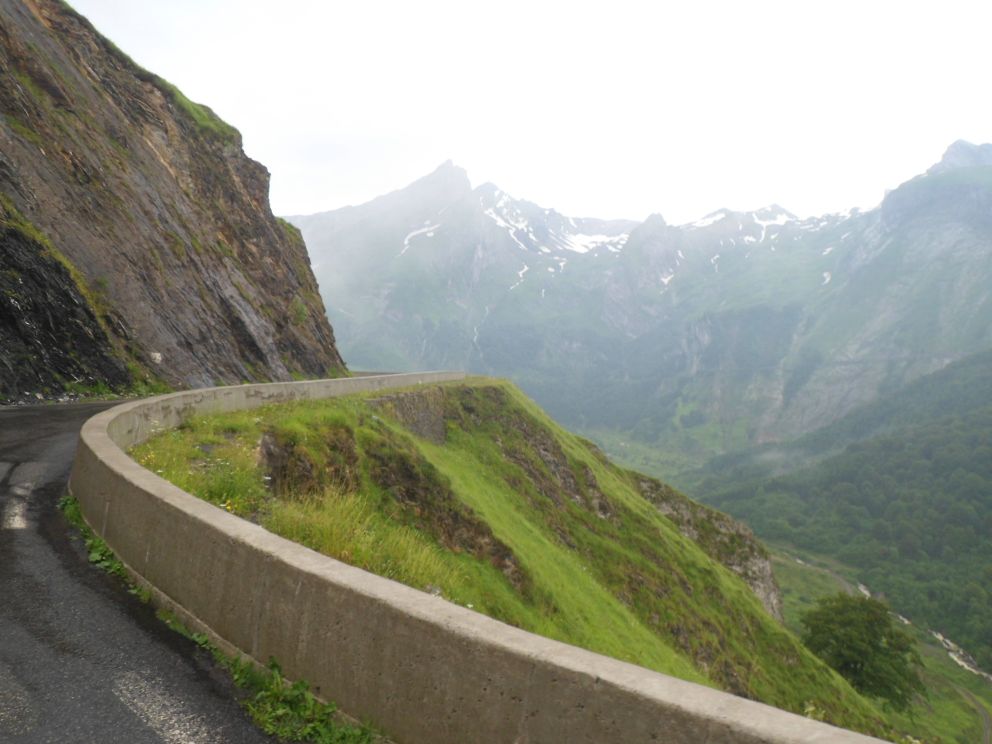
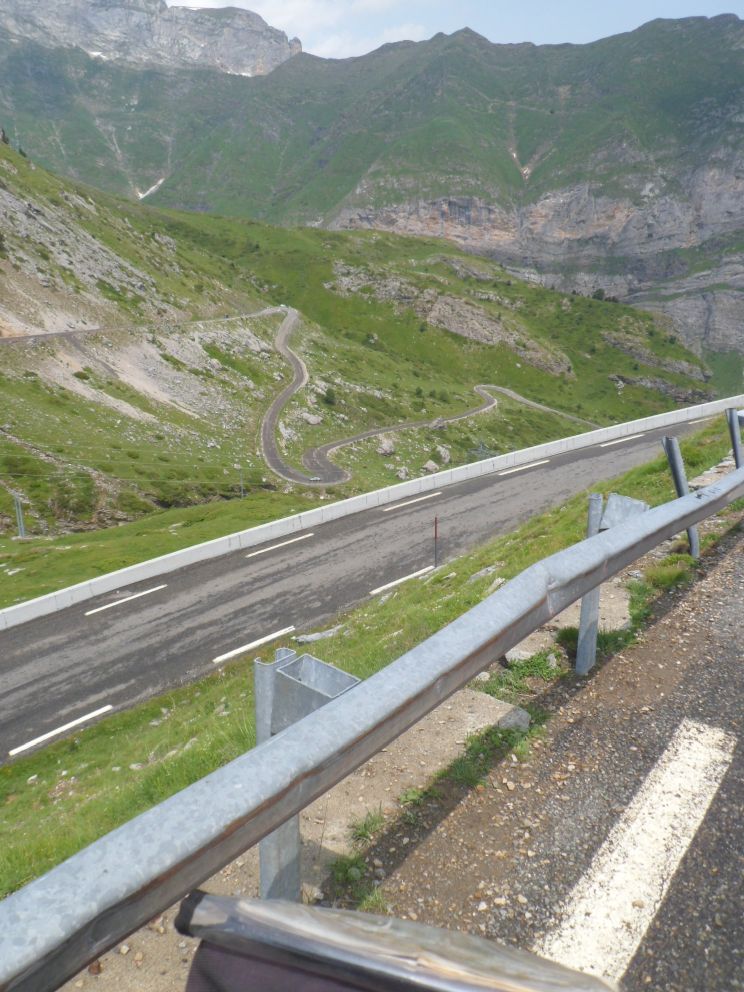
Descent from Col de Bagargui


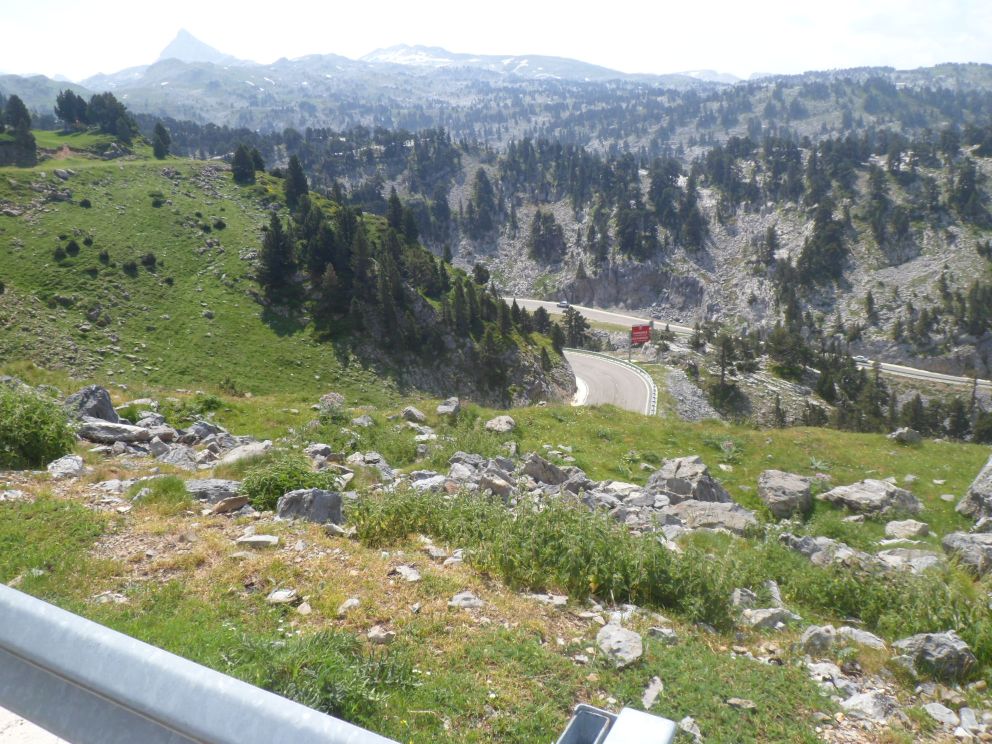
View back/up to Col de Bagargui

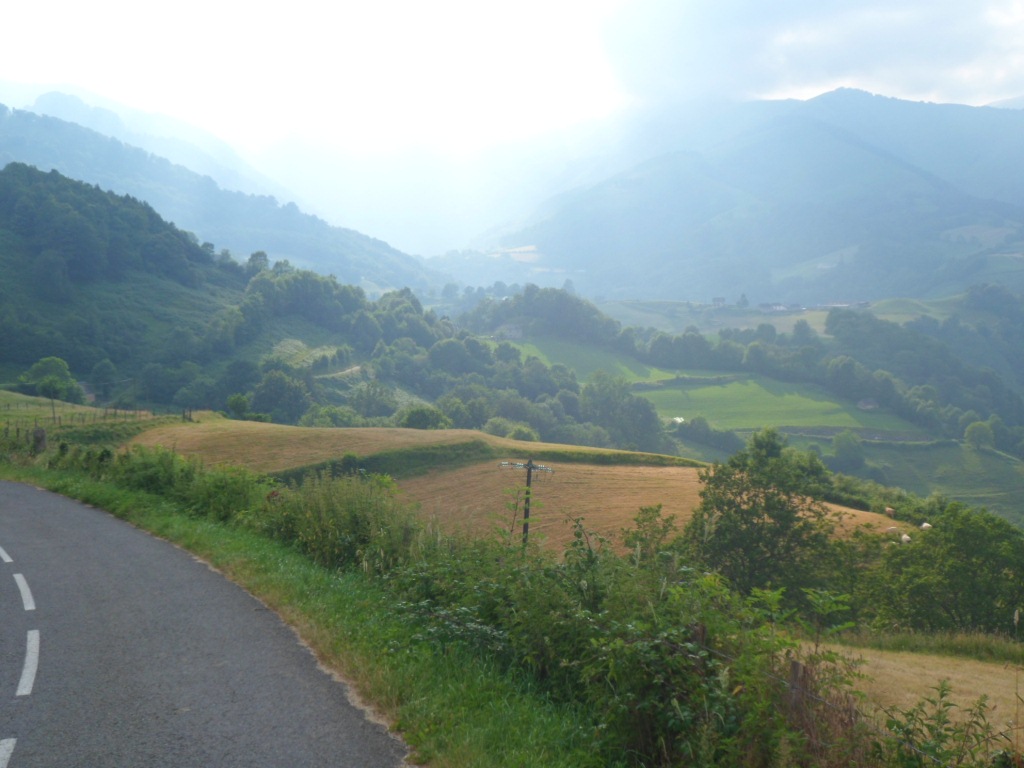
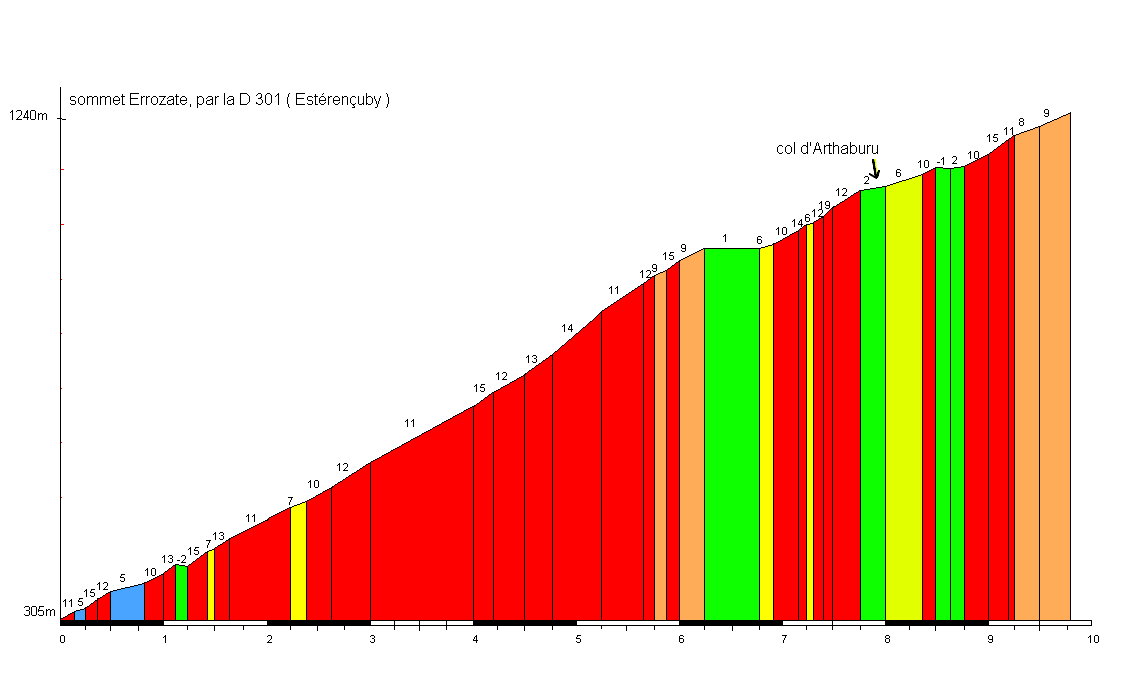
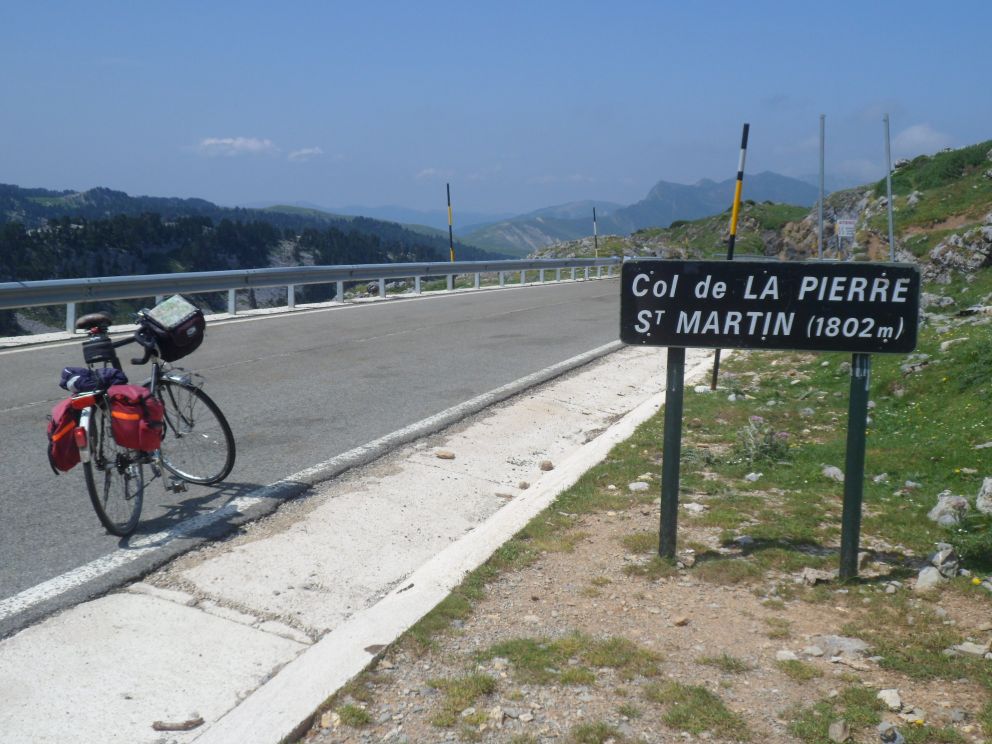
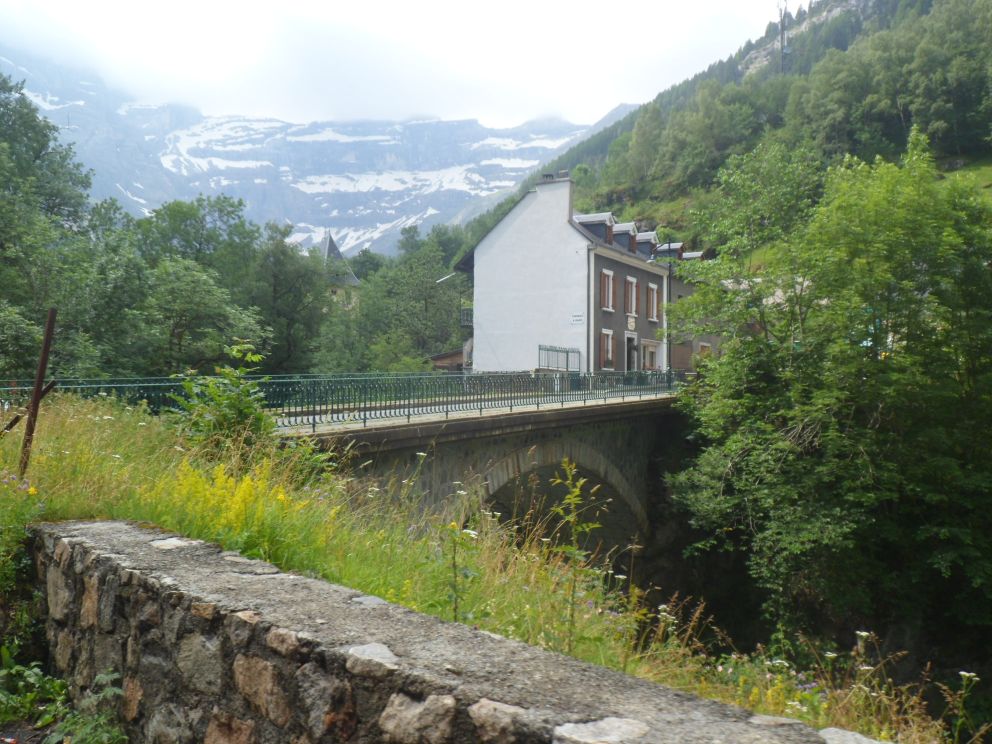
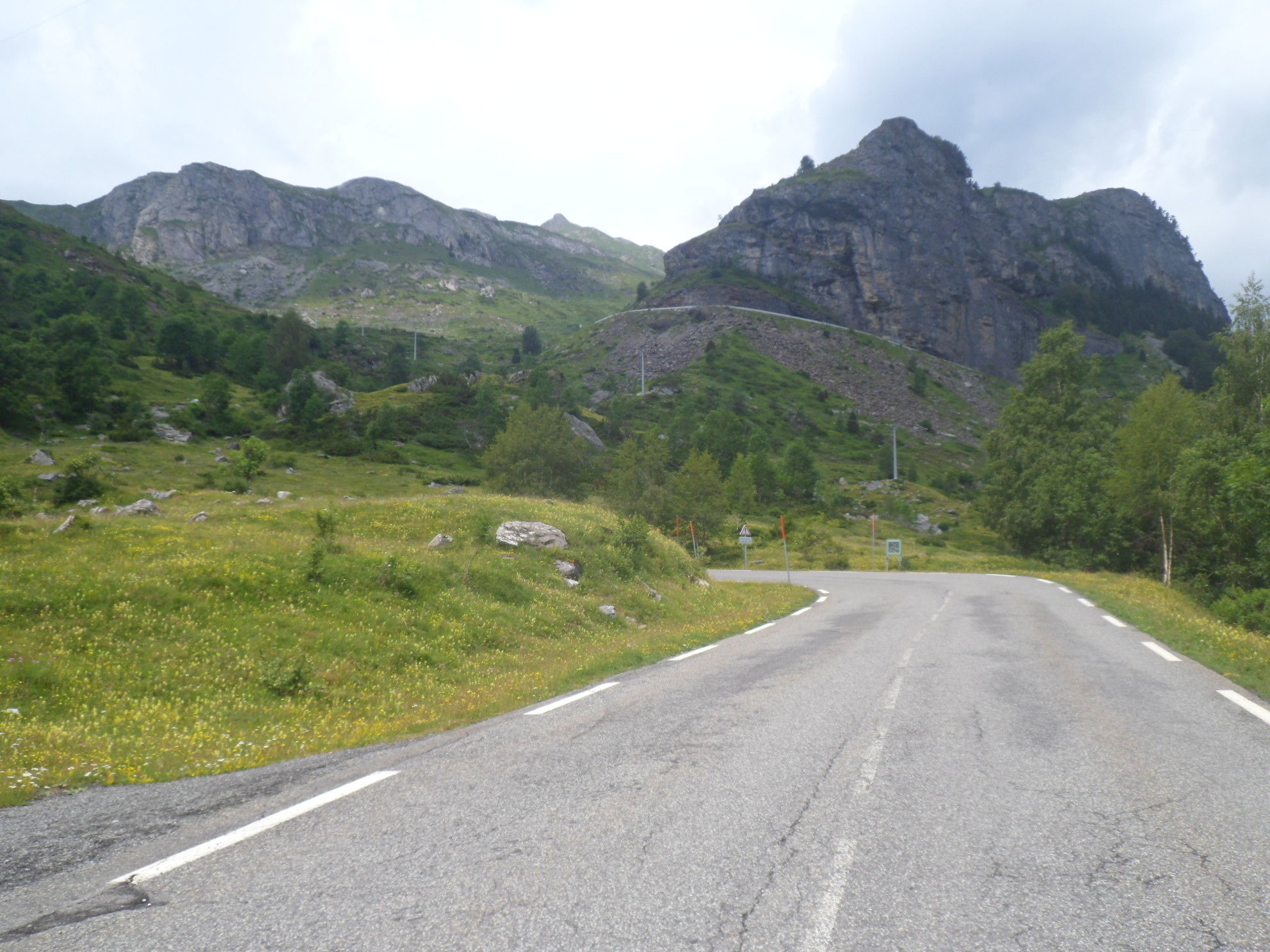
In Biarritz it's warm in a clammy ('Sri Lankan') way. There's my bike - I remove the improvised covers (I should have made a photograph!) - and around 10:30 I mount good old Koga. On the driveway out I change to cycling shorts - no one notices, I guess - and try to orientate myself, which is a bit hard with the sun behind the clouds. First French purchase: one and a half liter of water. It's not so hard to find the D932 to the Pyrenees; it's a pity it's rather a motor way, with separated lanes even. Next stop is half an hour or so later, when from the corner of my eye I notice 'cycles', and have my tubes inflated again - and they will stay well on pressure for the rest of the trip! That's nice, for now I can skip Cambo-les-Bains and get to the 'real business' of this first étape earlier. First stop in Bidarray, first a gâteau Basque, then a terribly steep road up (just doable by using the whole width of the road), to the supermarchée which I'm lucky to find is a bit slow (i.e. 20 minutes late) closing down for afternoon break. In Bidarray some children's sports event takes place, and while I'm enjoying my first coca cola (only on cycling holidays!) and currant rolls, me and my bike are surrounded by a dozen of inquisitive young brats, which I don't mind as long as they don't push over my bike. The sky has cleared; the views to the hills all around are very nice. I descend cautiously and continue my ride along the Nive - luckily the D932 has become quieter - slightly touching Saint-Jean-Pied-de-Port, until Estérençuby (wondering how this should be pronounced). I have a coffee in this (today) quiet village on an empty, sunny terrace, and have my two bottles refilled with nice cool water. Five km further, as the 'junction to hell' is already in view, I have a last refill, and some words of warning: 5 km with a grade of 12 percent. This I don't believe, but that the grades of the next 10 km are impressive I learned a few days before I left. However, 4 hours for 35 km should be doable, shouldn't it? The climb is certainly long and steep (the road goes up 800 m in 8 km); however, there are no extreme stretches above 15%. After two km I get some encouragement and enthusiasm ("extremely nice road") from an oncoming car driver, and later on - when I'm having one of two or three necessary breaks to regain my breath and lower my pulse - some information from an oncoming Belgian cyclist about the climbing still in store.


Nice starter, isn't it?


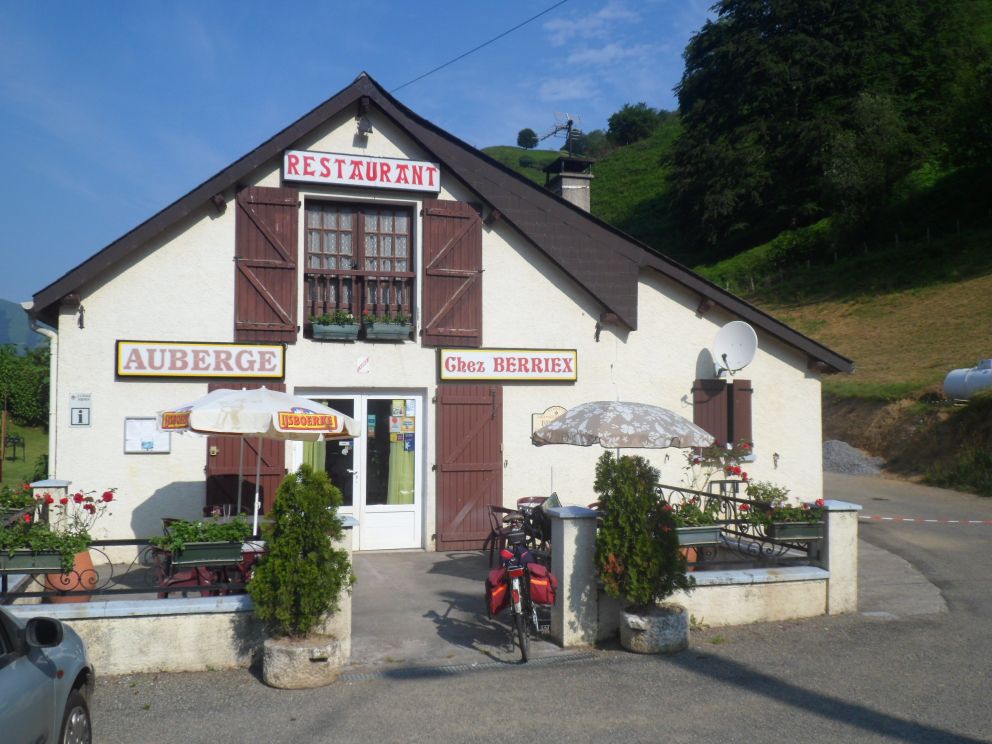
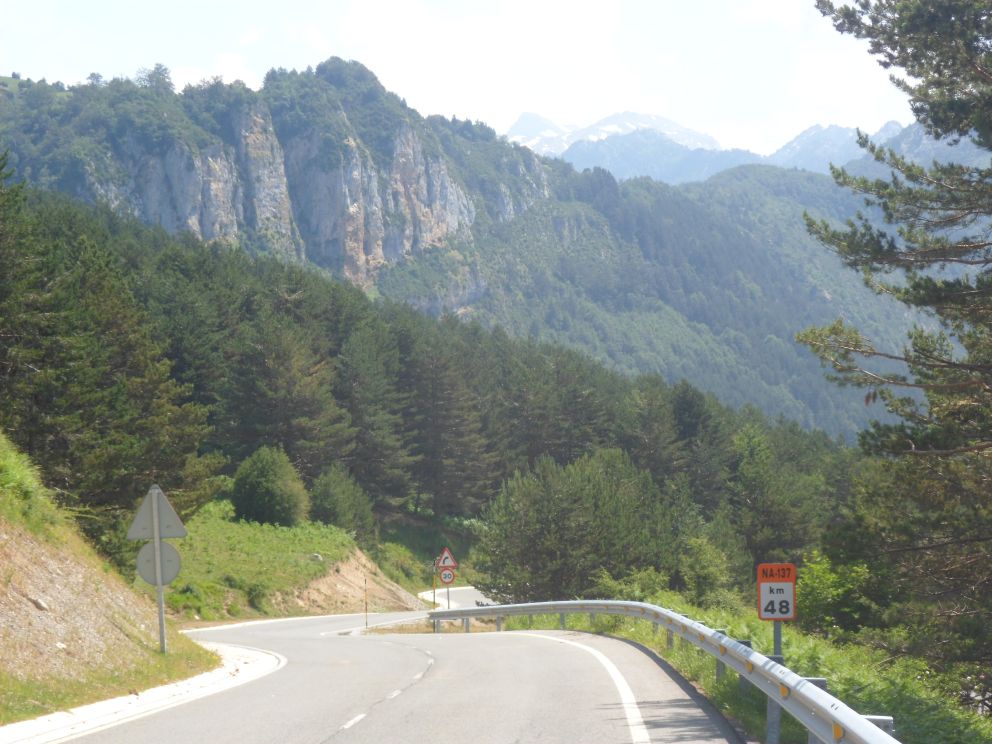
After the first 'pass' (Col d'Arthaburu? - no col sign) the road will continue rolling up and down. The road is quiet, the environment is wonderful; the breaks aside I have no energy (nor time) to make pictures. It lasts and it lasts - indeed going up, going down - and I have no idea of time and distance (my watch is in one of my bags, my odometer is still taped to a save place (to survive the loading into and from the plane). But around the time I'm starting to worry whether I'm on the right track the Châlets d'Iraty finally come into view. In 7 km I have to go up another 300 m, which looks just peanuts, but signs of exhaustion again force me to include another break (but hey, it's the first day, it's warm, and I'm not thirty anymore!) A nice surprise at the end: I'm mistaken about the distance, and reach the Col de Bagargui (for the first time since 1991) one km earlier than expected. After a short photo-stop I put on my helmet and start the dive down; at least, that's as how I remember it. I also remember the 'sink' two km before Larrau, but I don't remember the trees (in my memory it was a road along bare hillsides - but that's only the top half). The sunlight shearing the hills and colouring the clouds is wonderful. Alas the descent is over before I know it. In Larrau I do some little shopping (a 'Kronenbourg' a.o.) and learn that my first gîte is 2 km further down - and down indeed! - in Laugibar/Logibar. It's part of a bar/restaurant along the road, lively, and the people are nice. Dinner is outside, with many followers of the GR10, and is okay (the pumpkin soup is terrific). I share a four-bedded dormitory with a French family of three, of which the 18-20 year old son is most annoyed about the snoring of (both!) his parents. It makes me smile; I have come across much, much worse snorers in the past!


  14-07-2013     Laugibar – Laugibar     121 km

Breakfast is put in the fridge; coffee can be warmed up in the microwave; okay, this meal is certainly not haute cuisine. Different people are in different stages to get going; the family in my room is getting up when I'm arranging my things for this first étape sans bagage. It is a very nice, cool morning, which starts with some 10 km slightly downhill through the nice valley of the Gave de Larrau. Cool! The junction with the road to the first long climb comes too quickly. A sign gives precise information: in 21.7 km the road climbs from the present 304 m to the Col de Soudet at 1540 m. It's a quiet road, and the first 10 km not much altitude is gained. I pass the several villages that constitute Saint-Engrâce. I keep my eyes open for an alimentation which should be in one of these (as I'm told by the woman/tenant of the gîte), but find nothing. Buying food might become a problem, this (Sun)day. At a bar right after the last village I take a quick, early break with a coke. Not much later the real climb starts, and when I try to change gears to the smallest chain wheel my chain jumps off. (Three days later I manage to do this so smoothly that the problem no longer occurs.) The environment is gorgeous. I see (and smell!) the chestnuts. At a slow pace I leave km after km behind me (and meter after meter below me). It's too long to do it in one stroke, and when I take a short rest by the side of the road a car stops and the driver asks me whether I'm okay. Well, I am, only not (yet?) up to this exercise. I hope to find a shop in Arette-Saint-Martin (otherwise: not much chance of any food supplies today, apart from restaurants). By then I have already conquered the Soudet.


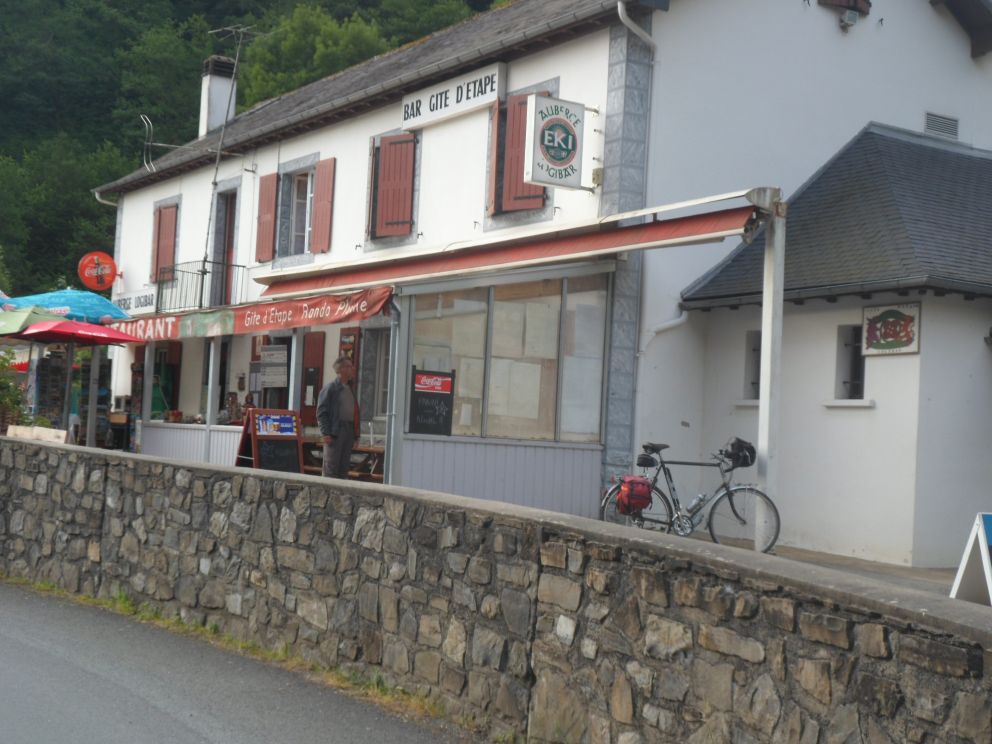
First gîte


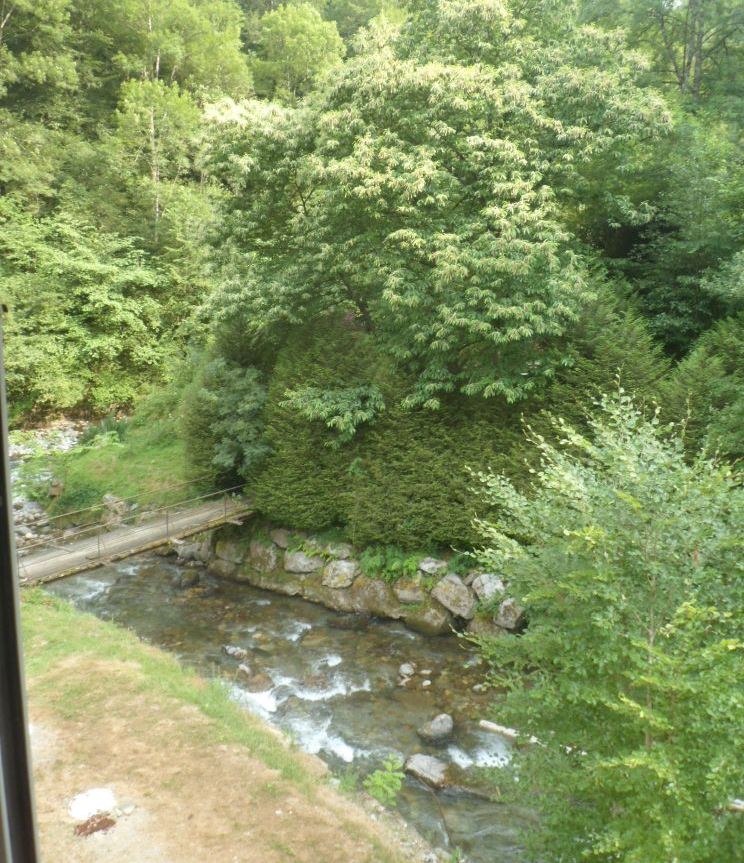
Gorgeous Gave de Larrau


In the beginning, up to Col de Soudet


After a short pause   . . . .


About halfway


Summit of today


A few minutes later,   "Spain, here I come"


Valley of the Belagua river


What a lot of snow there still is! Arette-Saint-Martin is quite an ugly skiing village, almost deserted on this summer day. The shop seems also half supplied, but there's enough choice left to not have to starve in the afternoon. The last kms up to the summit of the day, through a very nice, well-known scenery of white rocks with sparse firs, are not so numerous and not too steep. On the first two occasions I passed by here, in '87 and '91, from the south, I could only sense the beautiful environment, being in the clouds, even rain. Well, not so today, when there's also quite some snow still around. The descent goes in two stages, the second stage with nice views over the valley of the Belagua river (and a view quite high back/up from below). Last night I reckoned I could add another short climb on this otherwise quite short étape, and so I do, turning left onto the NA-2000 some 3 km before Isaba, to go some 400 m up to a col which I will baptize Alto de Zuriza. A nice, green, quiet road mostly along the Barranco de Belabarze, with the climbing in the beginning and near the end (as I could have guessed from the form of the road on the map). A picture at the col - on the border of Navarro and Aragon - and then a fast ride back to the main road, to Isaba. I choose a restaurant where outside a bike+trailer is parked. The owner of this, a Spaniard, is indeed inside, but alas is just breaking up. From the menu I choose a coffee and a bocadillo con queso Roncal, a choice I will regret: the bread+cheese is so dry that I can can hardly get it into my esophagus. And I read my first Spanish newspaper, of which some 25 per cent is written in a local language I do not master (and seems to me not to be Basque - not enough of the tx letter combination).


Magnificent south side   . . . .


. . . .   of Port de Larrau


So here we are again!   (4th time around)


Backyard of the gîte: Gave de Larrau

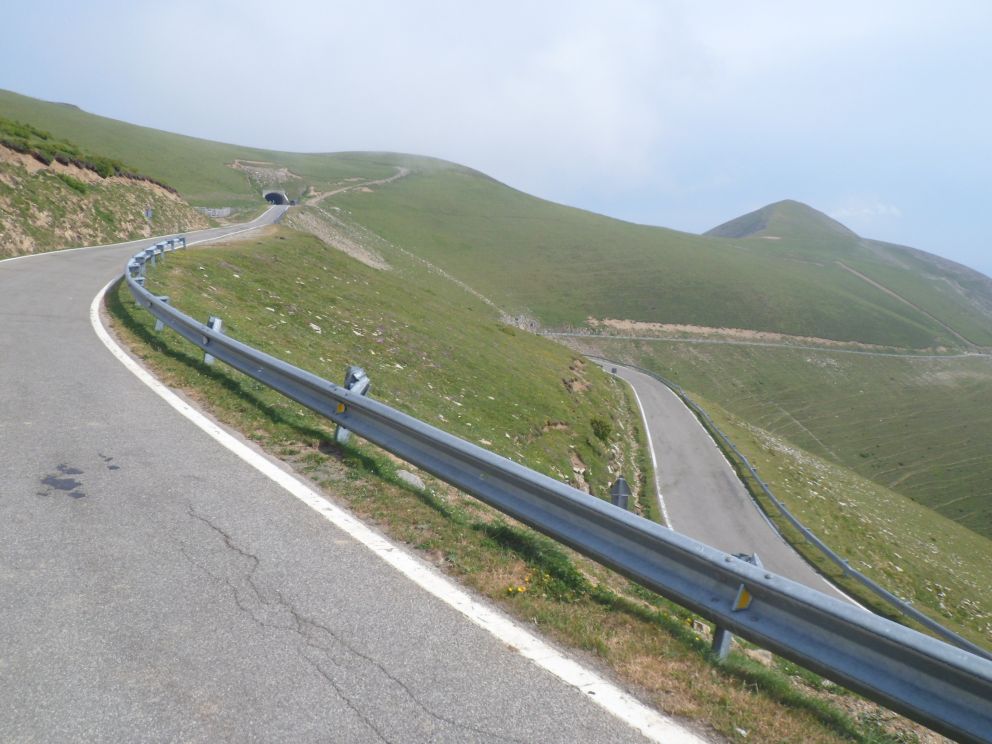
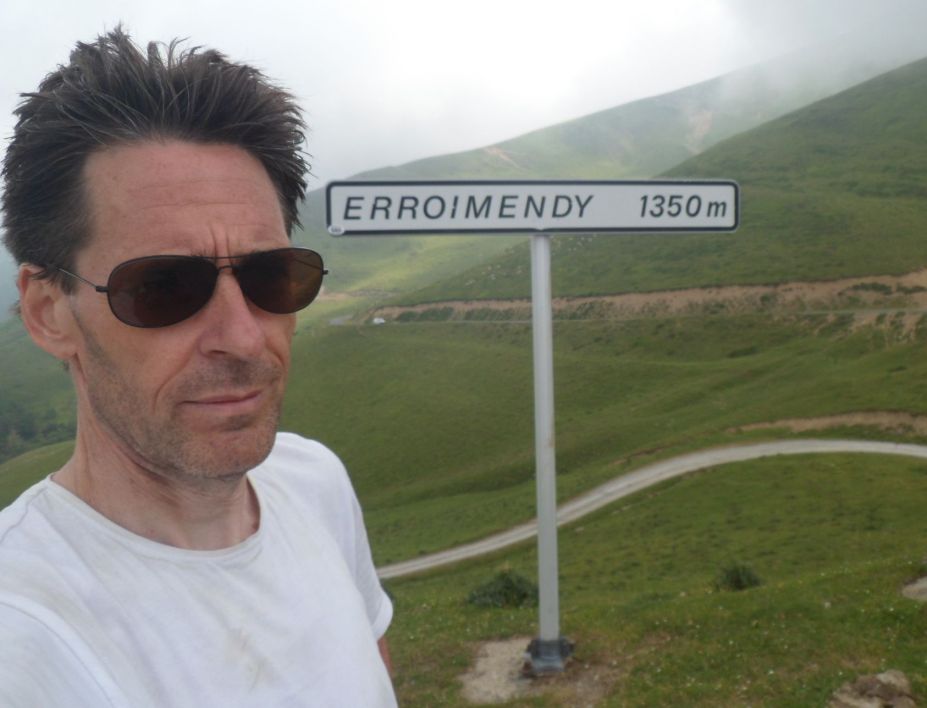
It's 3:30 p.m. and I 'set' the time to arrive at the Port de Larrau (25 km from Isaba) at 5:30 p.m.. First a slow, warm (though every now and then there is some shade) ride up to the Alto (de) Lazar, with two km of 7% at the end. A descent to the level of 900 m, and then a very regular 10 km climb (a steepest km of 8%) to arrive at 1575 m. With wind from the north, so that doesn't help! I only take a short break after 3 km to get rid of my T-shirt. Soon I get out of the trees, but the wind compensates for the direct sunlight, and higher up there are some thin clouds as well. I can still well remember the first time I did this pass from the north, during my first étape Pyrenéen ever, what a killer it was, and how thrilling the first half of the descent. Well, the view back/down right before the tunnel is still thrilling! I pass the summit without pausing, knowing there will be a small bump 4 km later at the Col d'Erroïmendy. There I stop for a photo, and a look at the time: 5:40 p.m. Quite good! I put on my T-shirt and helmet for the dive down - steep, steep, steep! - to Larrau - and - STEEP! - to Laugibar. Arrival at the gîte, with even a short break at the small alimentation in Larrau, at 6:03 p.m.   A completely new set of hikers there. I share the dinner table with people from France (well, hey!), Germany, England and Australia. The menu is the same as yesterday (and all yesterdays before?), but for me there is an alternative menu. The starter and the dessert were very nice, so I only change the main course. I share a room with Karl, a German of about 60, whom I warned of his severe sun burns, and who learned over dinner that it's no good only putting up sun cream between 7 and 8 a.m. Well, one is never too old to learn, is one!


  15-07-2013     Laugibar – Arrens-Marsous     134 km

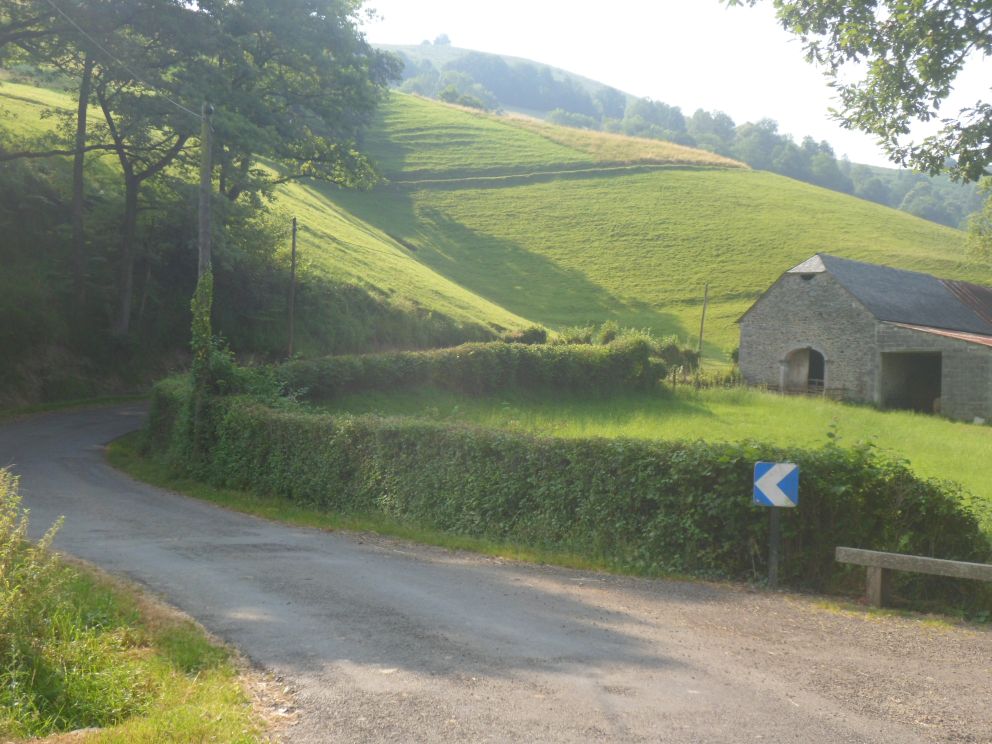
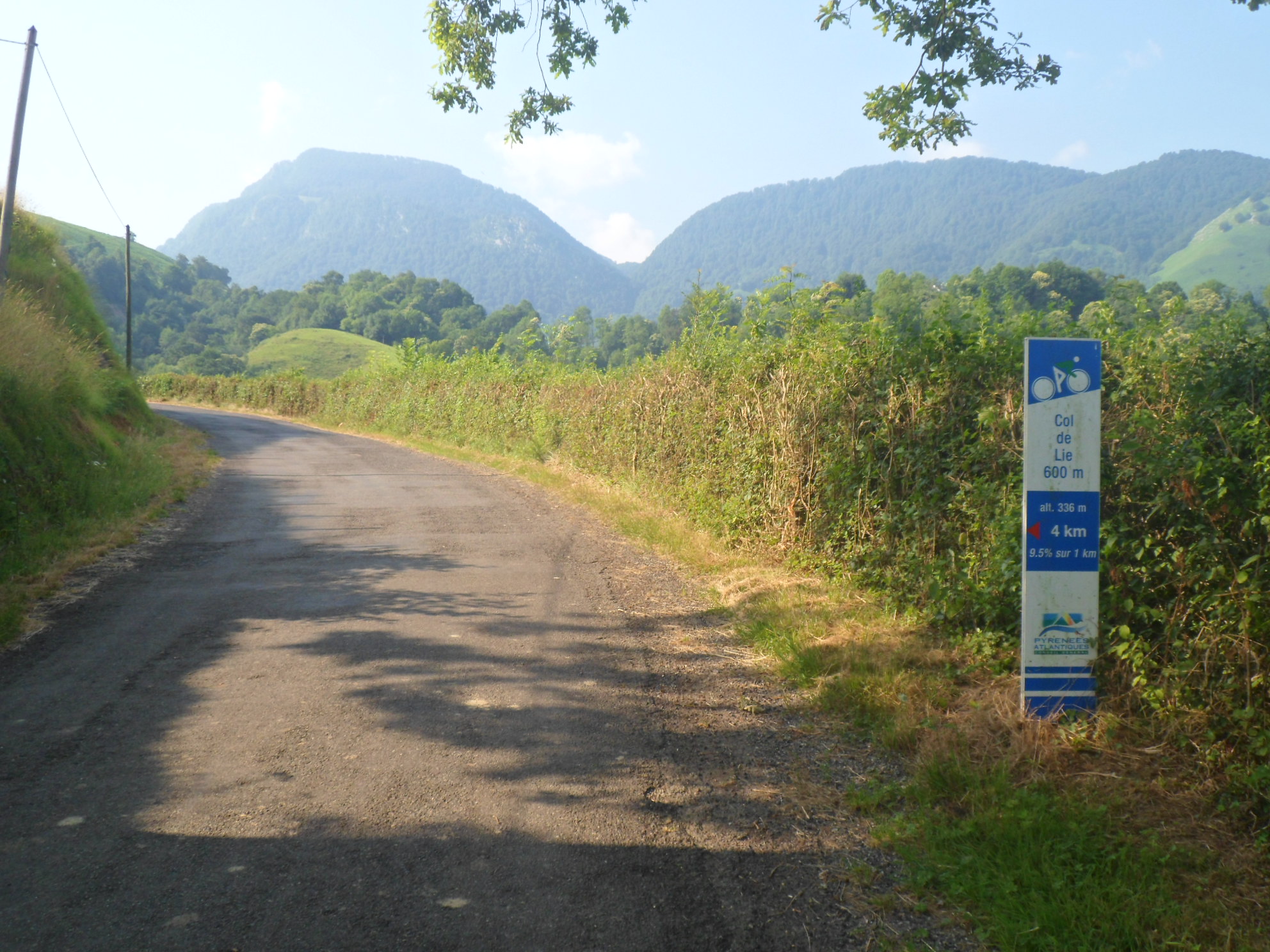
Alarm at 7 a.m. An annoying moment occurs when I open the fridge and notice that from 'my' corner the milk is taken. I suspect this trick is played on me by the French guy who yesterday so proudly boasted about his double daily distances (compared to all the other hikers), but I can't ask him as he has already left. Karl is still there, so I can hand over to him his gadgy toothbrush set that he has forgotten in our bathroom (otherwise I would have given it to one of the others with the same destination). Départ at 8 a.m. A delightful first half hour downstream along the Gave de Larrau on a beautiful morning. I turn left on the D918 (that one again) which goes up-and-down-and-up-and-down to Aramits, but I end up in Arrete, where I have coffee and news from the Tour (Froome wins again, at the Mont-Ventoux, Bauke Mollema does not lose time to Alberto Contador) on a terrace in the shade - it's no use getting too much sun.   As a 'starter' I have included the Col de Lié in my route. A nice one! A very tiny road, some 300 m up, with a few steep sections (1 km of 9.5%) that I can manage.


Nice sideway   . . . .


. . . .   up to col de Lié


1 km of 9.5%


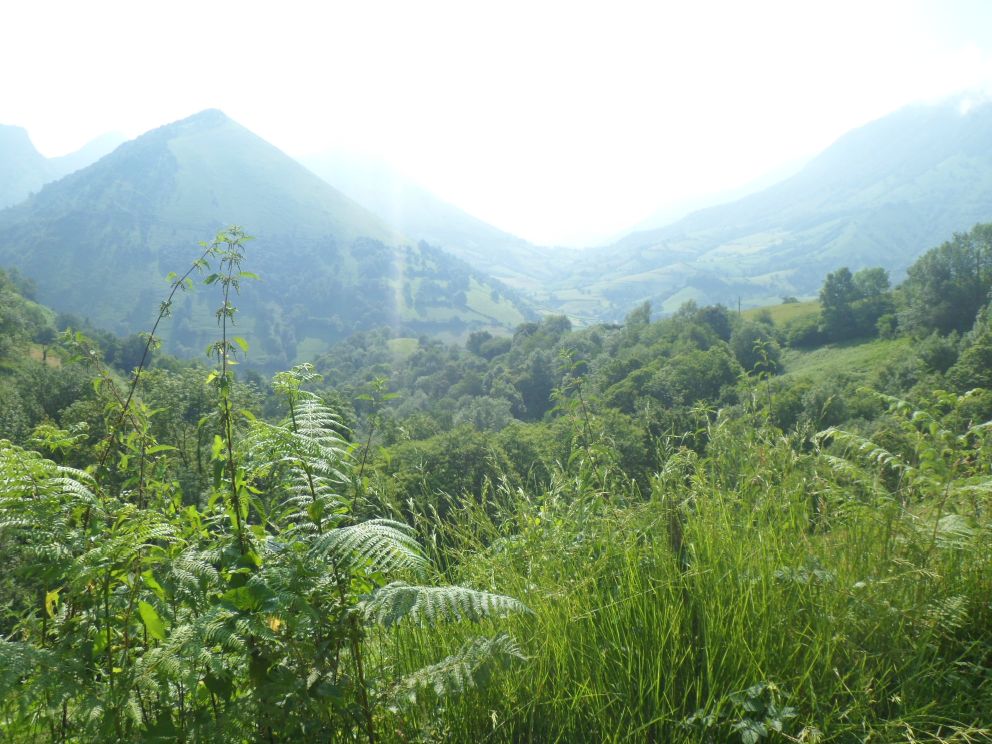
View to the valley of the Ichère

The sun still low, its light filtered by faraway clouds, gives the scenery something magic. I have always loved the wonderful area around Lourdios-Ichère, so green, so quiet. A narrow valley brings me back to . . . the D918. After Saint-Christau this is again an up-and-down going road, luckily not much frequented by other traffic (read: cars). Most of this part is through a dense forest. For a long while I hear the Aspe (or Ossau?) river, which I'm not going to see before I reach Arudy. There I find a Carrefour supermarket shortly before closing time, where I can buy all the things I need. I think I've earned a nice place to rest and eat, and I find it under a plane tree in a small park. During this lovely lunch I text to Oxana that life and weather are good in France. The second of these will soon deteriorate . . . However, this I don't foresee, so I give myself a protecting layer of sun oil before I mount Koga for a last 20 km along the D918 . . . during which I see thick clouds (thunderstorms?) coming up (or rather: down) from the south . . . the heat will only last another 10 km . . . and is most deeply felt during the first two, which do climb quite a bit. Surprisingly soon after I have turned right, into the Asson valley, the first rain drops start to fall, during the long preamble of the climb to the Col du Soulor. I don't want to stop to put my track jacket in a dry place since I have quite a good pace. I'm surprised to find that three times the road is split into two completely separate one-way lanes for a few hundred meters. Ferrières has been on the road signs from the start, so I expect to find a supermarket there.


Up to the Soulor; into the clouds


Higher and higher


but not drier


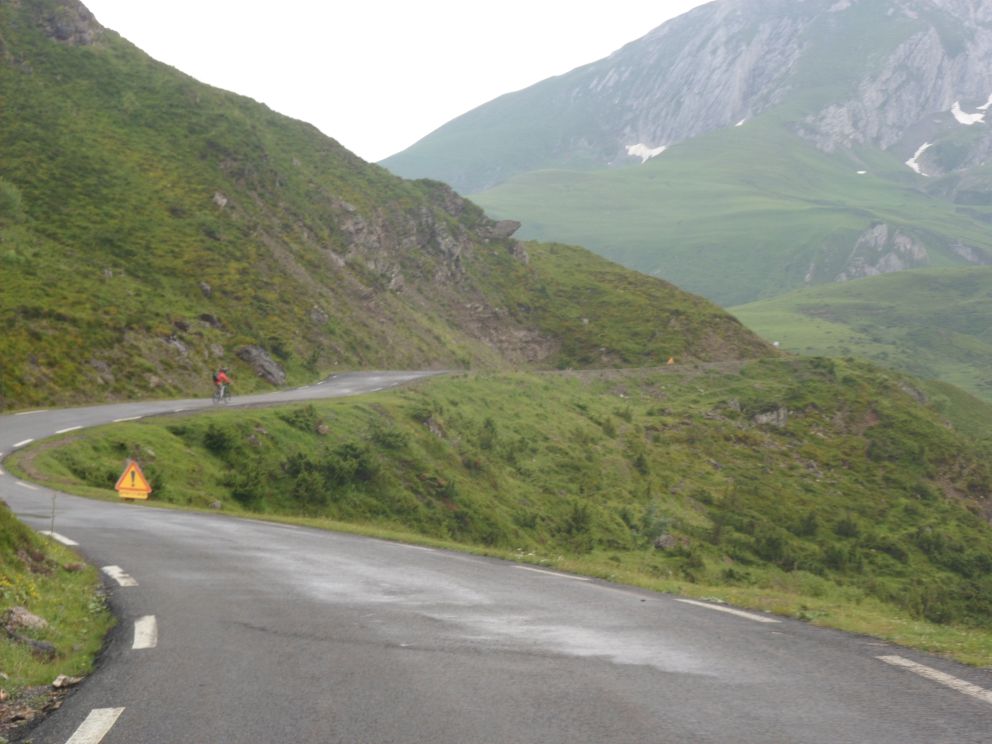
My red target close to the top

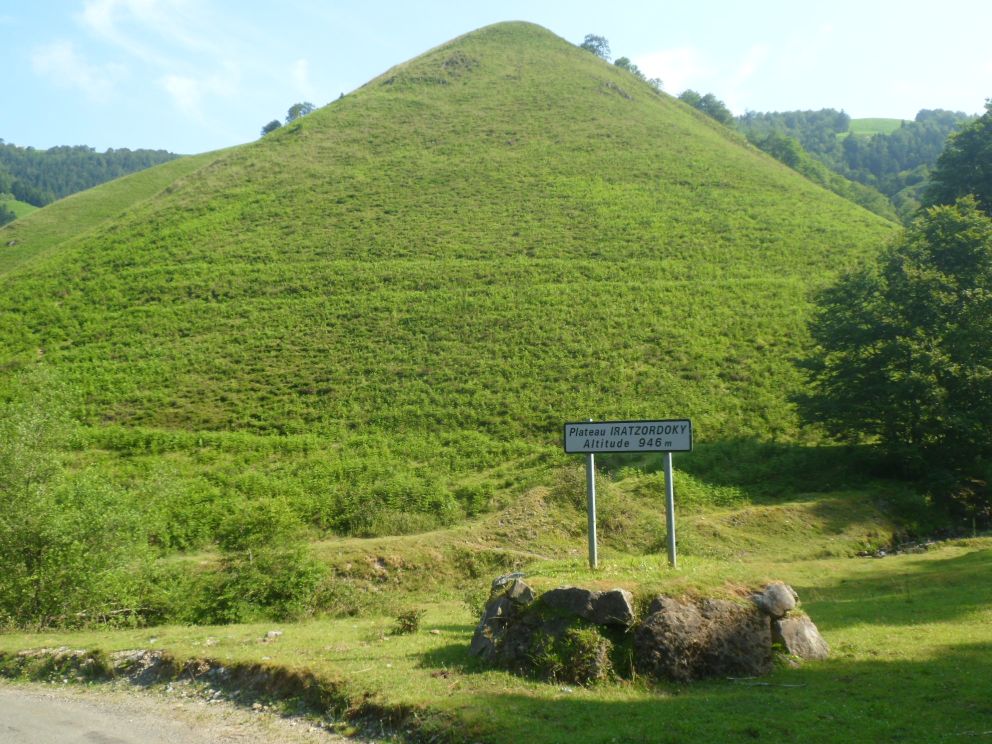
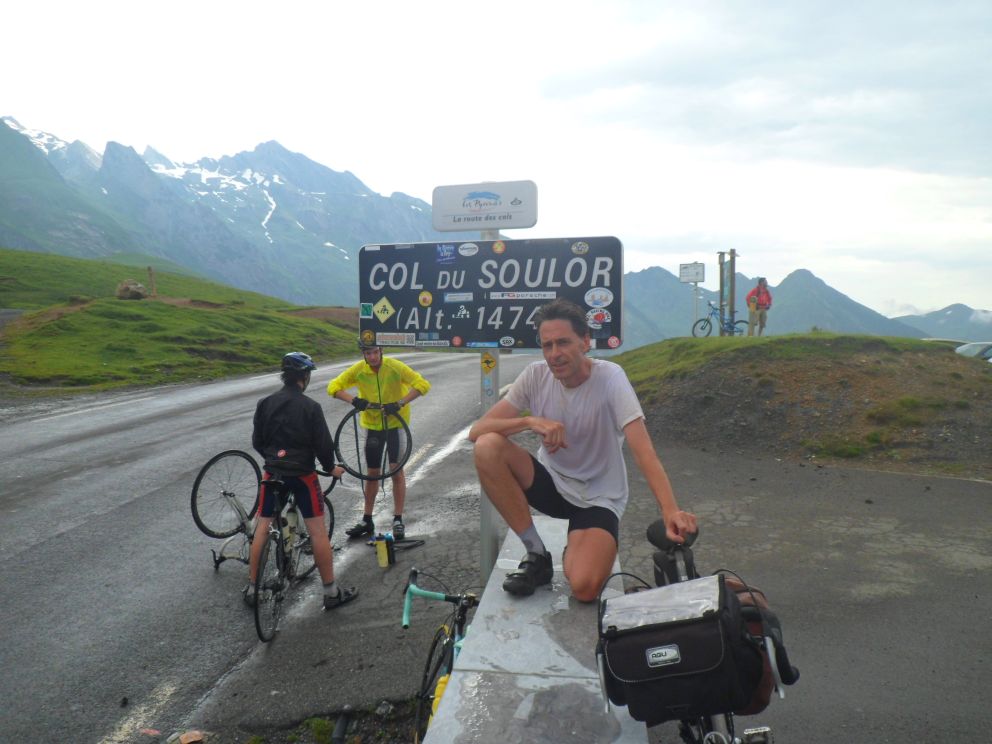
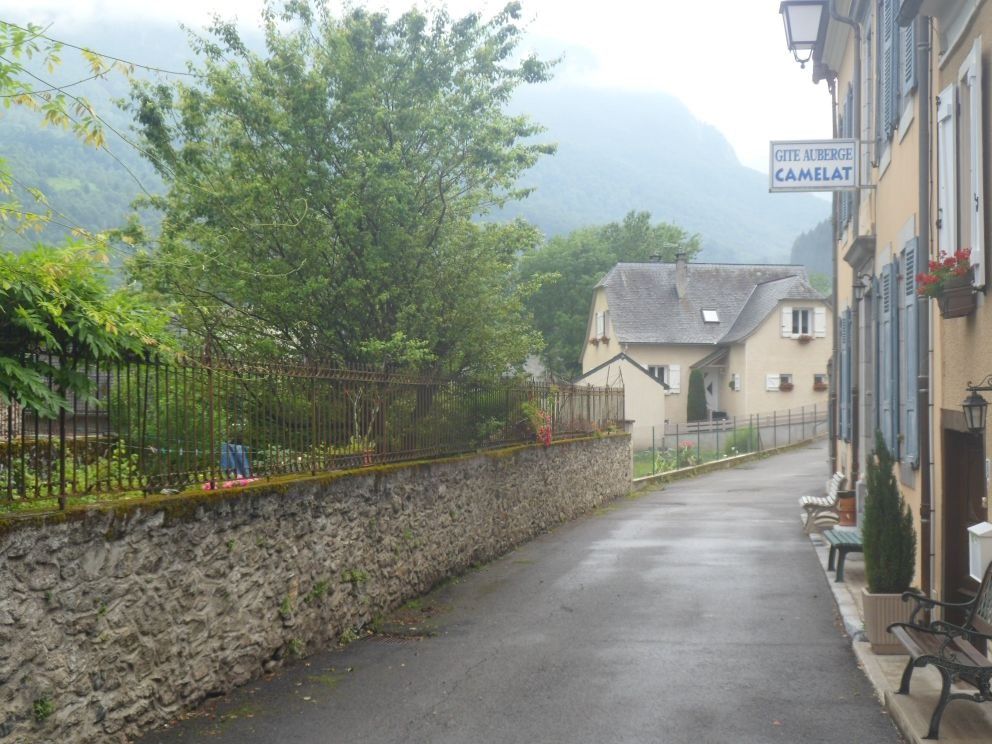
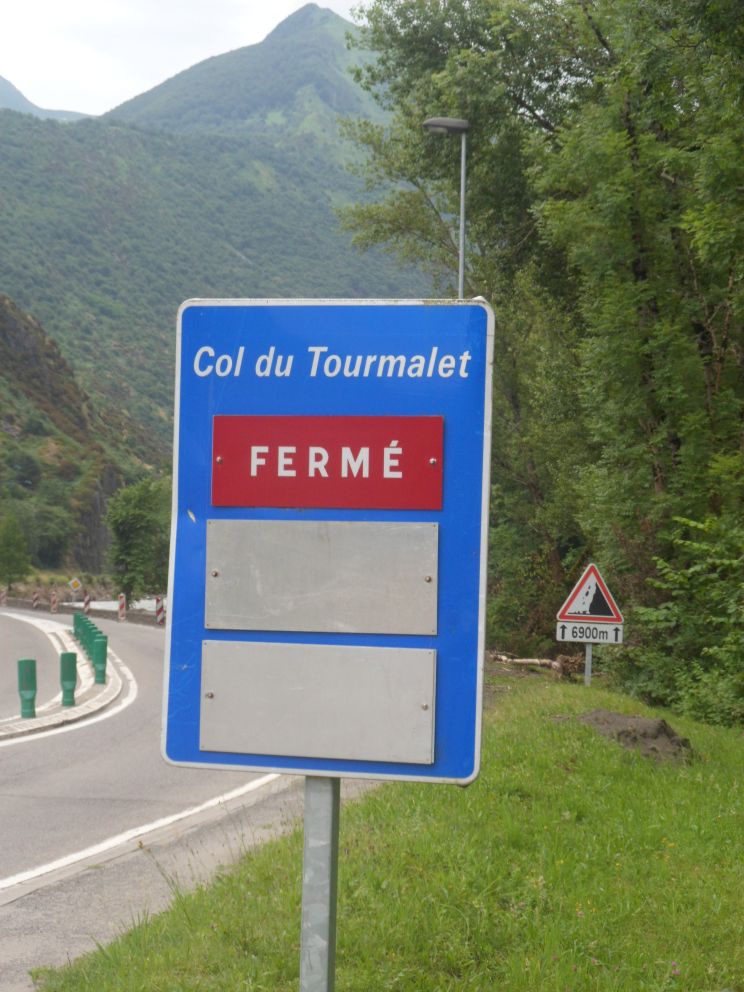
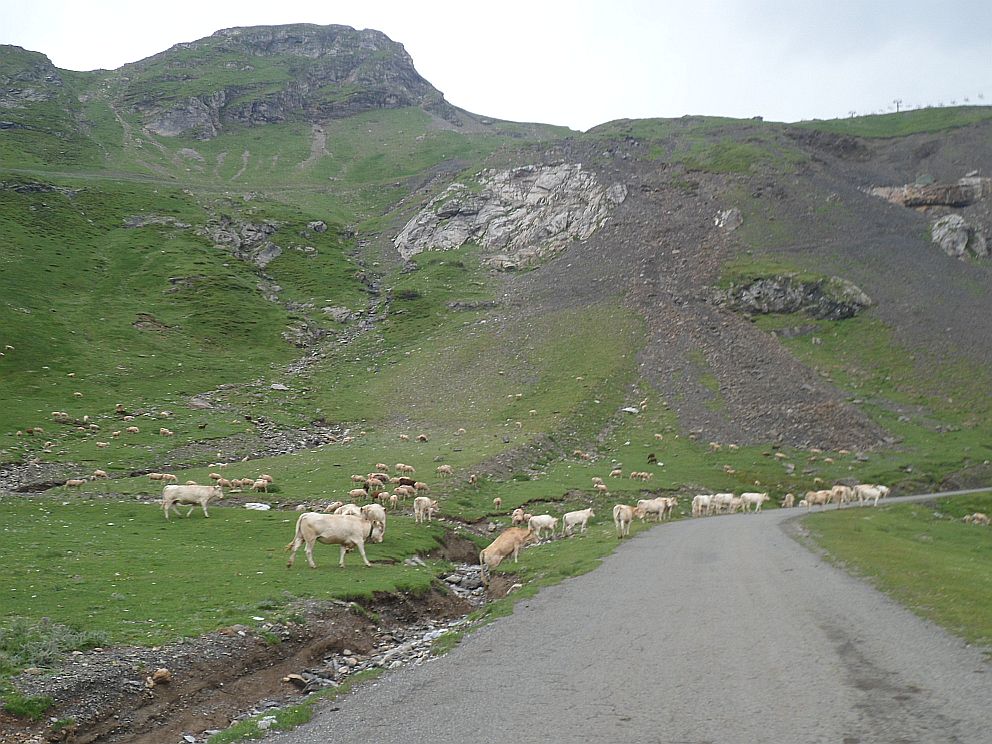
It seems no, until, a bit off the road, yes, behind a dwelling house. In the hall of this house I find a dry though rather primitive corner to sit down and eat and drink. From Ferrières it's 900 m up in 12 km, and indeed, the way out of the village immediately starts to go up at a rate of at least 5%. It's raining lightly, it's not very cold, so I ride up only in T-shirt. In fact, it's refreshing - only the views are rather disappointing - I can't see up to where I'm going. Halfway it stops raining, nice, and, also nice, I don't need my lowest gear for this climb of première catégorie. I can vaguely make out the road on the other side of the abyss, the road to the Col d'Aubisque. Thirdly nice, I slowly ride up to a 'colleague' until I pass him shortly before the col. There I'm welcomed by four fellow countrymen, one of whom photographs me in front of the col sign. They also inform me that the road from the west to the Tourmalet is closed as a consequence of floods in the spring. Fourthly nice: there's no rain during the descent to Arrens-Marsous, where the gîte Camilat is quickly found, where my single room is very basic, and where the dinner - with a small group comprising many nationalities again - is haute cuisine.


Rain and other 'troubles' at the top


My place of shelter


  16-07-2013     Arrens-Marsous – Arrens-Marsous     134 km

Alarm at 6:50, breakfast at 7. Weather forecast: same as yesterday ( = not too good). The sky is thickly covered indeed. I have decided to adapt my original plan for today (Tourmalet) by the Port de Boucharo, at 2270 m even a little higher, and with high probability the 'roof' of the whole tour. I climbed it only once, in 1991, also from Arrens (but ending in Luz Saint-Sauveur) in which period of my career I managed to include the climbs to the Cirque de Troumouse and Luz Ardiden in one étape. Nowadays I reckon I'll need ten hours to cover 125 km, so I decide to take the easy road to Argeles-Gazost, slowly downhill till the last 2 km, when suddenly it drops down uncomfortably steeply. The D921 to Pierrefitte-Nestalas is simply boring (as is the weather) and very busy with cars and camions. After Pierrefitte I have to wait ten minutes because of work on the road - not only the route to the Tourmalet is damaged. I 'forget' to make a picture of the three-meter wide hole in the road. The road to Cauterets is closed too during working hours, but the route I take offers no further delays. The Gave de Luz, on a nicer day it must be gorgeous to ride through it, today I'm worried about rain and thunderstorms. Well, only the first happens, enough to have me put on my rain jacket, but it's not too bad. In Gèdre there's even some sunshine. I have quite a long break in a rather shabby café.


Gray morning

       
Pity!


About the only patch of blue sky

When I leave there's even more sunshine, which makes the road to Gavarnie much nicer. A few hairpin bends in the beginning, and a slow rise, all in all 400 m up in 8.5 km, and at the end 'interesting' views to the Cirque (with loads of snow) in the south, and the up-going road in the south-west. This up-going road is the quite noteworthy climb to the Port de Boucharo, 800 m up in 10 km.


Cirque behind Gavarnie


'Interesting' ride up


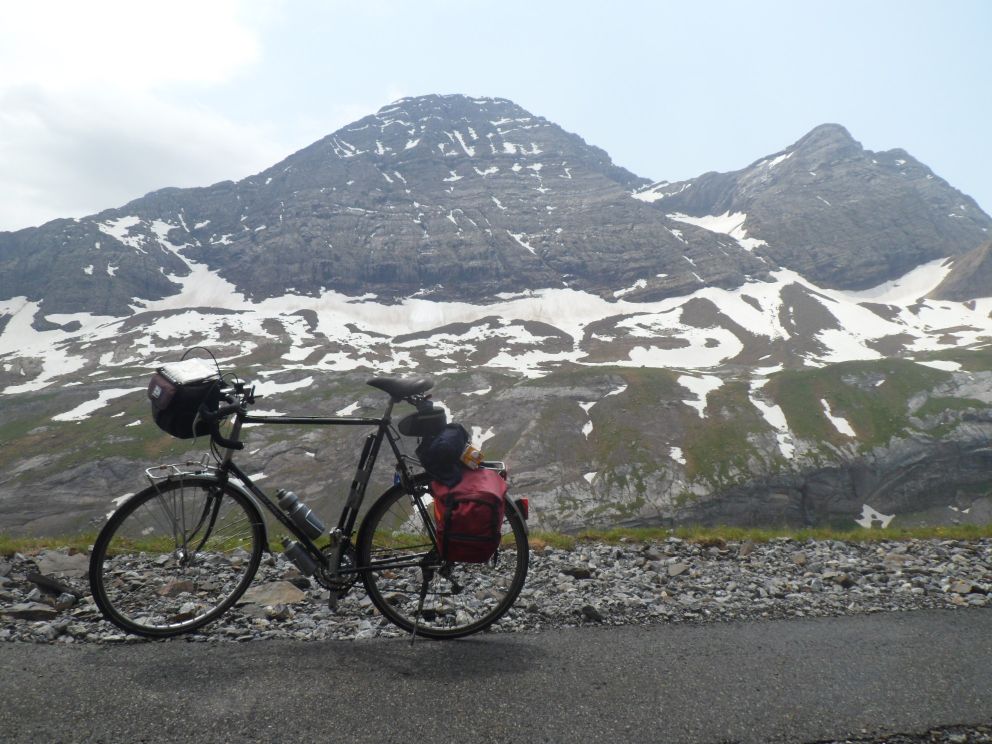
Getting close to Port de Boucharo


Around the   . . . .


. . . .   Port de Boucharo


Descent from Port de Boucharo

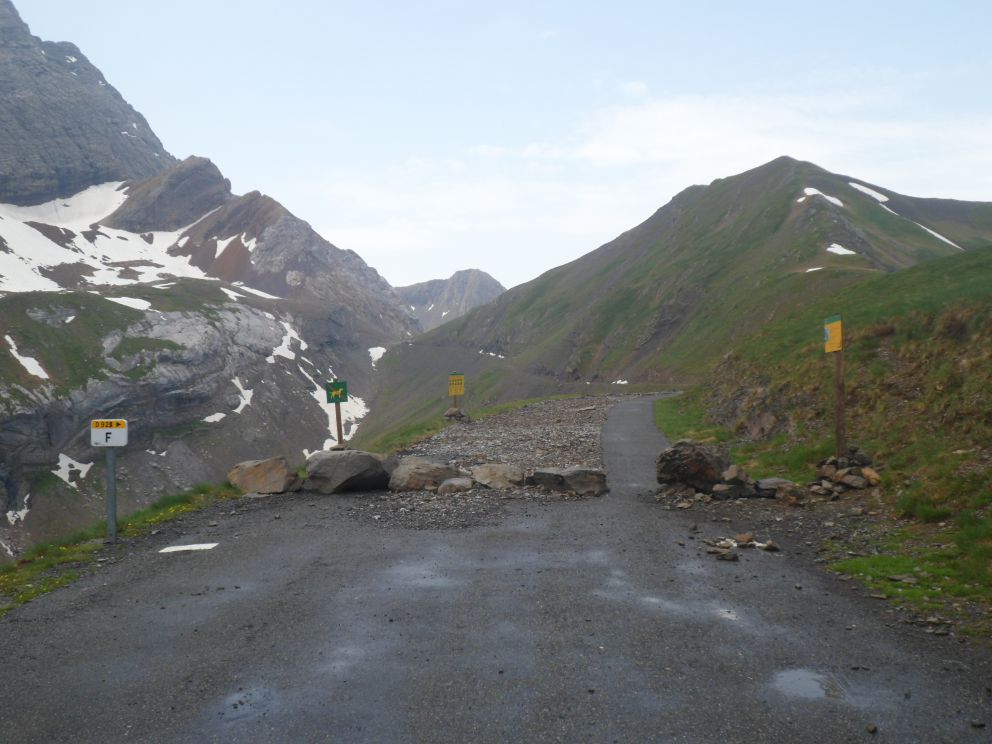
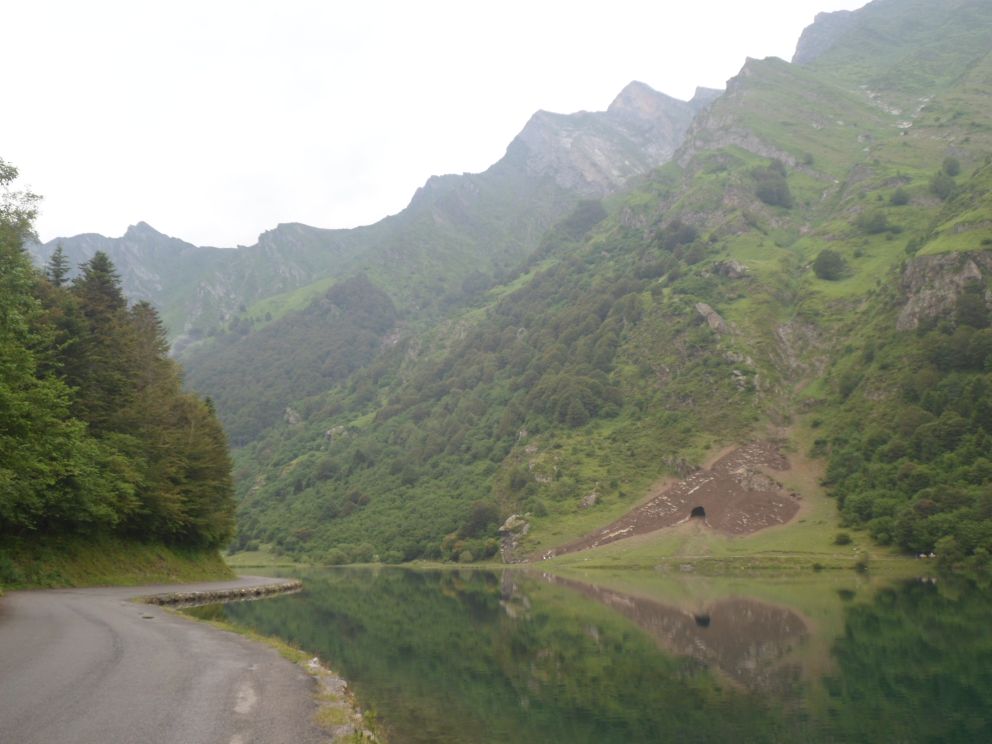
The climb offers nice views up (and later on, even better: down). Alas the weather is unpredictable. It starts to drizzle, growing to light rain. What worries me most are the thunderstorms high up coming nearer and nearer. The only shelter is at the endpoint of a télécabine, where I meet four bikers (with three motorcycles). The rain stops, the thunder doesn't come nearer, so I give it another go (deciding that when I'm bothered again by thunderstorms I will call it a day and turn around and descend to Luz Saint-Sauveur). Luckily the last three km to the 'top' go well, only the top comes 2 km earlier (and 80 m lower) than in '91 - I'm not in the mood to try the stony footpath that follows. I take a few pics, the scenery is gorgeous. Again: how much whiteness! I enjoy a quick descent to Gavarnie, to Gèdre even, and at a much slower pace to Luz Saint-Sauveur. I devour some baguette à Roquefort on a bench at a busy rond point in the company of a man who looks like a tramp, but tells me he is here on a holiday with his family (and indeed after a while he is picked up by a woman and a little kid in a car). The return along the Gave de Luz is the scariest part of the whole trip. First I'm almost run over by a car (the driver of which found it necessary to pass a few cars on a two lane road), second it starts to rain SO hard (bad views, slippery road with gusts of water) that even some drivers park their cars on the roadside for a while. Obviously my time hasn't come yet: I survive these adventures! In Pierrefitte-Nestalas it's sort of dry when I turn left onto the small D13, to avoid the busy route via Argeles-Gazost, and at the same time avoiding the thunderstorms as well, it seems. I hear the rolling of the thunder on the other side of the valley, but it doesn't come nearer. The road is going up most of the time, I pass several villages, all being candidates to give shelter might the rain get too hard. With my rain coat on I get quite warm. Well, the rain stops, and I come to an agreement with myself to add the short detour to and from the Lac d'Estaing should it stay dry till Estaing, the village. It does stay dry, so I climb another 160 m (in 4 km), make some pictures to 'prove' my having been there, and return to the foot of the Col des Bordères.


Lac d'Estaing


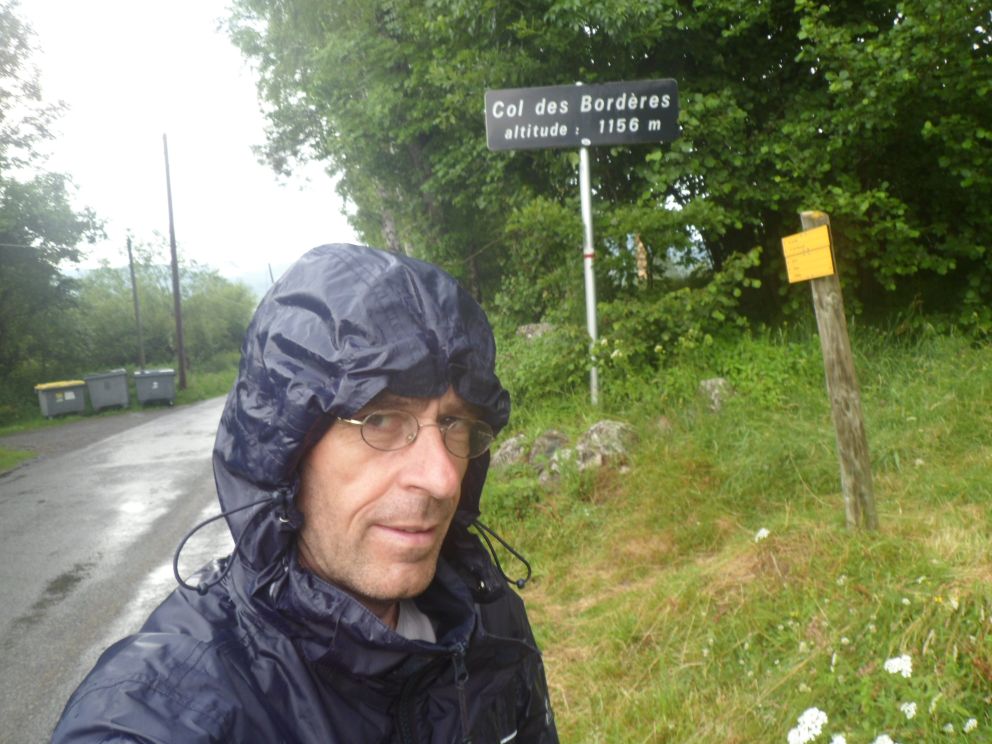
Wet arrival at Col des Bordères

I've just started this short, steep climb, when a sudden downpour of rain forces me to put on my rain jacket a last time, and soaks my socks in two minutes. With my cap far over my eyes I creep upwards, and after five minutes it's dry again. Well, not my cap, but ....  A quick descent, in time to buy some postcards, and have a hot shower before another delicious meal. The same gazpacho for a starter, but then a nice paella and a home-made tarte aux fruits. The gîte is complet tonight, but I only have contact with three school mistresses (one of them already retired) from the Vendée. I catch up with my writing in my room and again I'm too tired to mind the nearby church bells.


↓   ↓   ↓
   Next day