Research Interests

Machine Learning

Aritificial intelligence (AI) and machine learning (ML) have seen a leap forward in popularity in the last years. Our research in this field mainly focusses on scientific machine learning, where we combine deep-learning techniques with classical numerical methods such as Isogeometric Analysis.

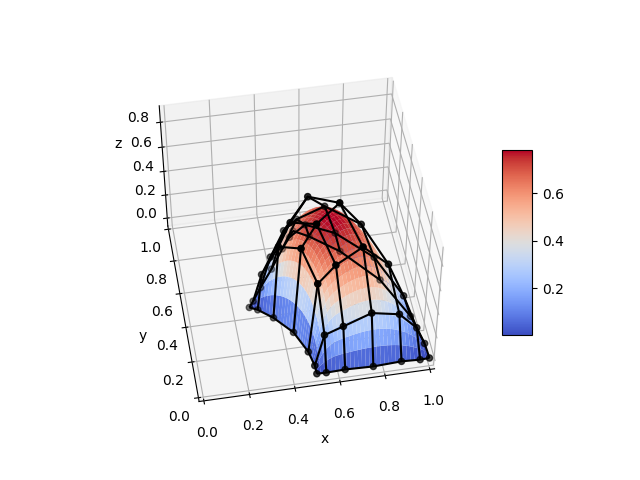
The figure below shows two solutions to the two-dimensional Poisson equation predicted by a deep neural network. Following the IGA paradigm, geometry, boundary conditions, and the solution are represented in terms of B-spline bases. The network inputs/outputs are the respective coefficients, which makes the evaluation of the trained network for changing problem instances straightforward.
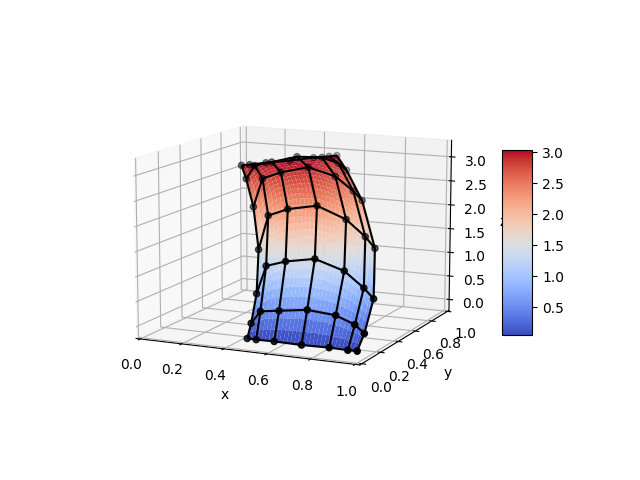
Solution to Poisson's equation predicted by a
                    physics-informed neural network approach embedded into
                    the isogeometric analysis formalism Solution to Poisson's equation predicted by a
                    physics-informed neural network approach embedded into
                    the isogeometric analysis formalism

Credits: Frank van Ruiten, 2020

We modified the above approach to design free-form optics that generate a specific target light distribution.
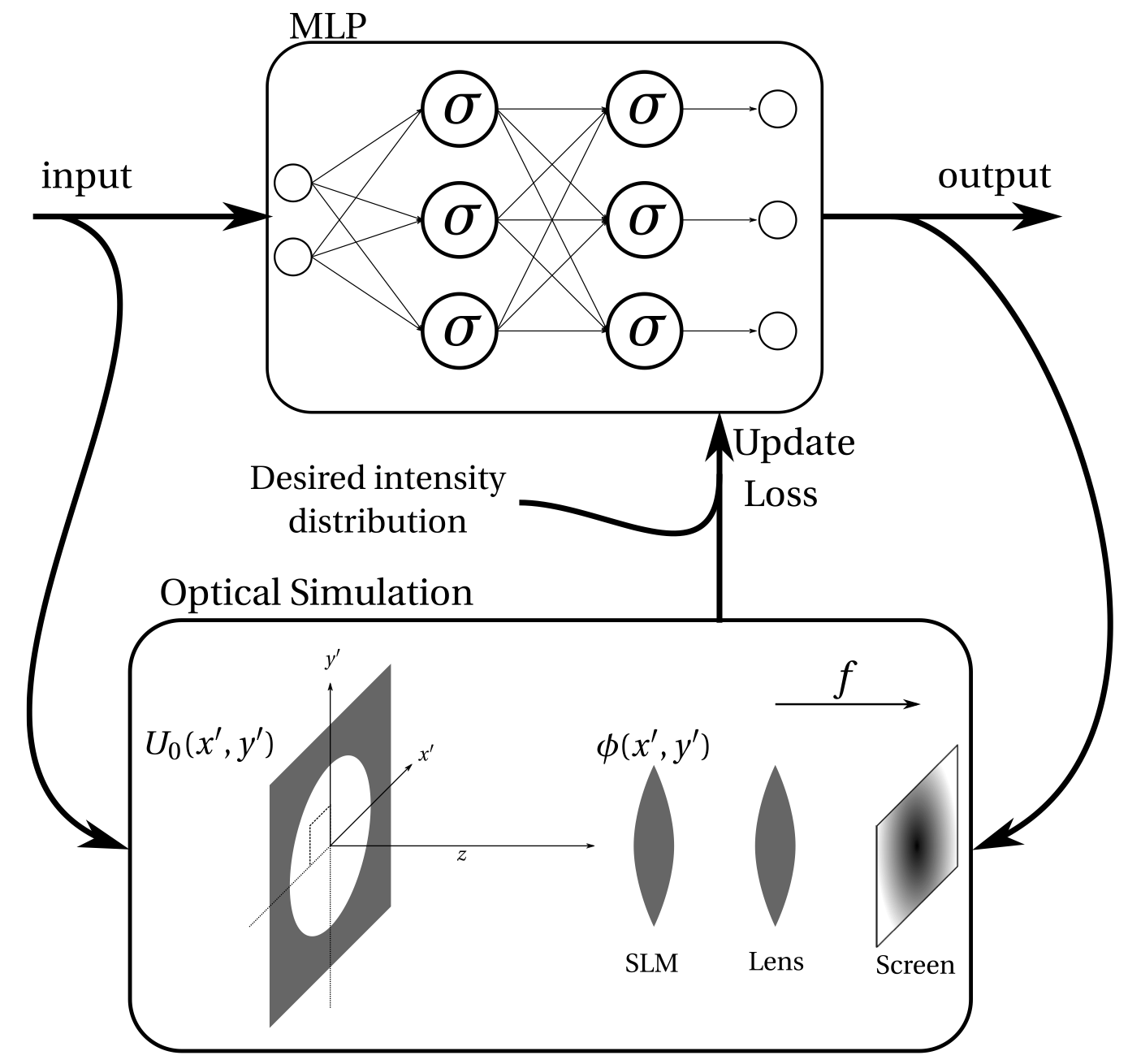
Solution to Poisson's equation predicted by a
                    physics-informed neural network approach embedded into
                    the isogeometric analysis formalism

Credits: Lucas Crijns, 2021

Selected contributions

  1. Matthias Möller, Günther Obermair, Isabella Singer, Christian Gollmann, Alessandro Reali, and Stefanie Elgeti. IGANets: Isogeometric analysis networks and their applications to linear structural analysis problems. Engineering with Computers, 42(3), May 2026. [ DOI | http | bib ] ( citation counts in OpenAlex 1 | Scopus 1 | Scholar 0 )
  2. Alexander Heemels, Bart de Koning, Matthias Möller, and Aurèle Adam. Optimizing freeform lenses for extended sources with algorithmic differentiable ray tracing and truncated hierarchical B-splines. Optics Express, 32(6):9730, March 2024. [ DOI | http | bib ] ( citation counts in OpenAlex 16 | Scopus 16 | Scholar 11 )
  3. Bart de Koning, Alexander Heemels, Aurele Adam, and Matthias Möller. Gradient descent-based freeform optics design for illumination using algorithmic differentiable non-sequential ray tracing. Optimization and Engineering, September 2023. [ DOI | http | bib ] ( citation counts in OpenAlex 9 | Scopus 8 | Scholar 10 )
  4. Dylan Everingham. Topology optimization and physics-informed neural networks for metamaterial optics design, 2022. [ http | bib ] 
  5. Samarth Kakkar. Physics-informed deep learning for computational fluid flow analysis: Coupling of physics-informed neural networks and autoencoders for aerodynamic flow predictions on variable geometries, 2022. [ http | bib ] 
  6. Bart de Koning. Designing free-form optics for multiple-source illumination using differentiable ray-tracing and neural networks, 2022. [ http | bib ] 
  7. Marek Oerlemans. Diffractive optical elements are all you need: Designing an optical system using physics-informed and data-driven methods, 2022. [ http | bib ] 
  8. Frank van Ruiten. PINNs for parametrized problems, 2022. [ http | bib ] 
  9. Rana Sannia Ul Haq. Stabilizing convection-dominated flow problems using neural networks based on flux-limiting techniques, 2022. [ http | bib ] 
  10. Lucas Crijns. PINN inspired freeform design: Using Fraunhofer diffraction to find freeforms described by B-spline surfaces, 2021. [ http | bib ] 
  11. Fernando Wanguemert Guerra. Physics informed neural networks, a new approach for the solution of PDEs, 2021. [ http | bib ] 
  12. Matthias Möller, Deepesh Toshniwal, and Frank van Ruiten. Physics-informed machine learning embedded into isogeometric analysis. In Mathematics: Key enabling technology for scientific machine learning. Platform Wiskunde, 2021. [ http | bib ] 
  13. Merel Schalkers. Learning based hardware-centric quantum circuit generation, 2021. [ http | bib ] 
  14. Jort Bouma. Using a physics-informed neural network to solve the ideal magnetohydrodynamic equations, 2020. [ http | bib ] 
  15. Joost Imhoff. Freeform lens predictions by a neural network and B-splines, 2020| bib ] 
  16. Susan Veldkamp. Het ontbinden van een matrix m.b.v. een getraind neuraal netwerk, 2020. [ http | bib ] 
  17. Franziska Riegger. Image segmentation of the γ'-phase in nickelbase superalloys utilising deep learning, 2019. [ http | bib ]